
Cost, Brightness, Lifespan & Performance Comparison for Smarter Outdoor Lighting
By Elemon.co.uk – Products of Tomorrow… Today.
Introduction
Solar vs Wired; Outdoor lighting has evolved dramatically over the past decade. Homeowners across the UK are no longer choosing garden lights purely for decoration—they’re investing in security, energy efficiency, smart automation, and long-term value.
Whether you’re illuminating a garden path, highlighting flower beds, creating a welcoming patio, or improving home security, one question always comes up:
Should you choose solar garden lights or wired garden lighting?
At Elemon.co.uk, we believe the best technology is the technology that suits your lifestyle—not simply the most expensive option.
This comprehensive guide compares both systems in depth, examining:
- Initial purchase costs
- Installation expenses
- Running costs
- Brightness levels
- Battery technology
- Lifespan
- Reliability in UK weather
- Smart home compatibility
- Environmental impact
- Maintenance requirements
- Best use cases
By the end of this guide, you’ll know exactly which option is right for your garden.
Why Garden Lighting Matters
Garden lighting isn’t only about aesthetics.
A well-planned lighting system can:
- Improve home security
- Reduce trip hazards
- Highlight landscaping
- Increase property value
- Create outdoor entertaining spaces
- Enhance smart home automation
- Reduce energy consumption
Modern lighting technology now allows homeowners to achieve all of this while keeping electricity bills low.
Understanding Solar Garden Lights
Solar lights generate their own electricity.
During daylight hours, photovoltaic panels collect sunlight and convert it into electrical energy.
That energy charges rechargeable batteries inside the light.
After sunset, built-in sensors automatically switch the LEDs on.
No wiring.
No electrician.
No electricity bills.
How Solar Lights Work
Every solar light contains:
- Solar panel
- Rechargeable battery
- LED module
- Light sensor
- Control circuit
Premium models also include:
- Motion sensors
- Smart brightness control
- Replaceable batteries
- USB emergency charging
- Wi-Fi or Matter compatibility
Understanding Wired Garden Lights
Wired systems receive electricity directly from your home’s electrical supply.
Depending on the installation, they may operate using:
- 230V mains
- Low-voltage transformers
- Outdoor-rated cabling
- Smart lighting controllers
Unlike solar lights, they provide consistent illumination regardless of weather.
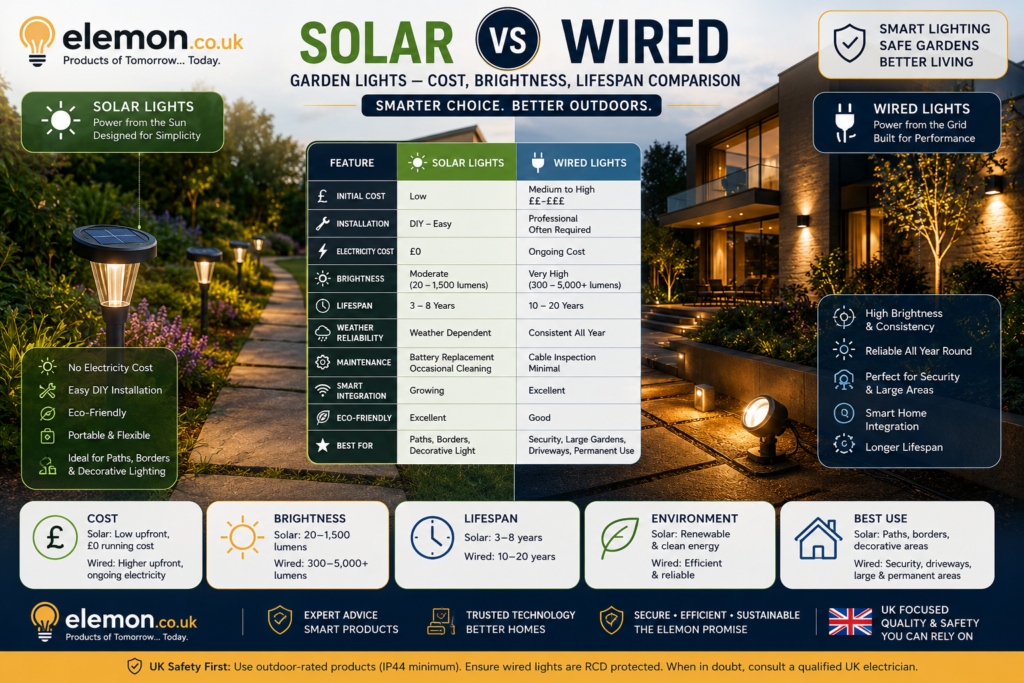
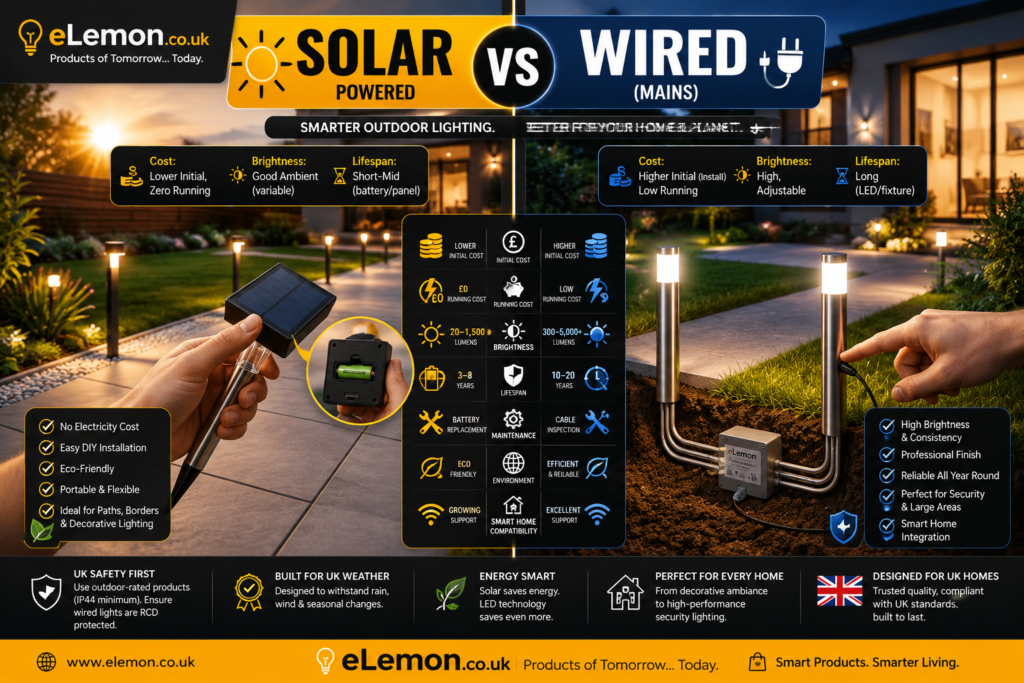
Solar vs Wired Garden Lights at a Glance
| Feature | Solar Lights | Wired Lights |
|---|---|---|
| Initial Cost | Low | Medium to High |
| Installation | DIY | Often Professional |
| Electricity Cost | £0 | Ongoing |
| Brightness | Moderate | Very High |
| Reliability | Weather Dependent | Consistent |
| Maintenance | Battery Replacement | Cable Inspection |
| Lifespan | 3–8 years | 10–20 years |
| Smart Integration | Growing | Excellent |
| Eco-Friendly | Excellent | Good |
| Expandability | Easy | More Complex |
Cost Comparison
Cost is usually the first deciding factor.
Solar Lighting Costs
Typical UK pricing:
| Product | Average Price |
|---|---|
| Path Lights | £15–£40 |
| Spotlights | £25–£70 |
| Wall Lights | £30–£90 |
| Decorative Lanterns | £20–£60 |
| Motion Lights | £35–£120 |
Installation:
£0 if installed yourself.
Wired Lighting Costs
Equipment:
| Product | Average Price |
|---|---|
| LED Spike Lights | £40–£100 |
| Flood Lights | £50–£180 |
| Wall Lights | £60–£250 |
| Transformers | £40–£120 |
| Outdoor Cable | £2–£6 per metre |
Professional installation can significantly increase the total project cost, especially where new cabling or trenching is required.
Long-Term Running Costs
Solar
Electricity consumption:
£0
Maintenance:
- Battery replacement every few years
- Occasional panel cleaning
Wired
Running costs depend on:
- LED wattage
- Daily operating hours
- Electricity tariff
- Number of fixtures
Modern LED systems remain efficient, but they still add to household energy use over time.
Brightness Comparison
Brightness is measured in lumens.
| Application | Recommended Lumens |
|---|---|
| Decorative Lighting | 20–100 |
| Pathways | 100–300 |
| Flower Beds | 150–400 |
| Patios | 300–800 |
| Security | 700–2000+ |
Solar Lights
Typical output:
- 20–500 lumens
- Premium models: up to 1,500 lumens
Wired Lights
Common output:
- 300–5,000+ lumens
Winner: Wired lighting for maximum brightness and consistent performance.
Lifespan Comparison
| Component | Solar | Wired |
|---|---|---|
| LEDs | 25,000–50,000 hours | 30,000–60,000 hours |
| Battery | 2–5 years | Not applicable |
| Fixture | 3–8 years | 10–20 years |
| Cable | None | 20+ years |
Solar lights often require battery replacement before the LEDs wear out, while quality wired installations can serve for many years with minimal intervention.
UK Weather Performance
The UK’s changing seasons can affect outdoor lighting.
| Season | Solar Performance | Wired Performance |
|---|---|---|
| Summer | Excellent | Excellent |
| Spring | Very Good | Excellent |
| Autumn | Good | Excellent |
| Winter | Moderate | Excellent |
Cloudy days reduce charging efficiency, so solar lights may not maintain maximum brightness for as long during winter.
Maintenance Requirements
Solar Lights
Routine care includes:
- Cleaning the solar panel
- Replacing batteries when needed
- Removing leaves or dirt
- Checking waterproof seals
Wired Lights
Maintenance generally involves:
- Inspecting cables
- Cleaning lenses
- Replacing failed LEDs or drivers if required
- Ensuring outdoor electrical fittings remain weatherproof
Environmental Impact
Solar Lighting
Advantages:
- Renewable energy
- Zero operational emissions
- No ongoing electricity use
- Lower lifetime carbon footprint
Considerations:
- Batteries should be recycled responsibly.
Wired Lighting
Modern LED wired systems are energy-efficient, but they still rely on electricity from the grid. Choosing efficient LEDs and smart controls helps reduce environmental impact.
Smart Home Compatibility
Both lighting types are increasingly compatible with modern smart home ecosystems.
Features available include:
- Motion activation
- Timers
- Sunrise/sunset automation
- Voice control
- Mobile app scheduling
- Scene creation
Wired systems currently offer broader integration options, although premium solar models continue to improve.
Best Applications
Solar Lights Excel For
- Garden paths
- Decorative borders
- Flower beds
- Temporary lighting
- Rental properties
- Quick DIY projects
Wired Lights Excel For
- Driveways
- Security lighting
- Large gardens
- Outdoor kitchens
- Permanent landscaping
- Entertainment areas
Pros and Cons
Solar Garden Lights
Pros
- No electricity costs
- Easy DIY installation
- Environmentally friendly
- Portable
- Minimal disruption to the garden
Cons
- Dependent on sunlight
- Lower brightness
- Battery replacement required
- Reduced winter performance
Wired Garden Lights
Pros
- Consistent brightness
- Reliable year-round
- Longer fixture lifespan
- Excellent for security
- Broad smart home support
Cons
- Higher installation cost
- Electricity consumption
- Cabling required
- Less flexible to relocate
Which Option Offers Better Value?
| Homeowner Type | Best Choice |
|---|---|
| First-time homeowner | Solar |
| Budget-conscious | Solar |
| Large landscaped garden | Wired |
| Security-focused | Wired |
| Decorative garden | Solar |
| Smart home enthusiast | Wired or Hybrid |
| Eco-conscious homeowner | Solar |
| Permanent outdoor renovation | Wired |
Hybrid Lighting: The Best of Both Worlds
For many UK homes, a hybrid approach delivers the greatest flexibility.
A typical setup might include:
- Solar stake lights along pathways.
- Wired spotlights for feature trees and architectural elements.
- Solar decorative lanterns around seating areas.
- Wired motion-activated floodlights near entrances.
- Smart timers or sensors to automate both systems where possible.
This combination keeps installation costs manageable while ensuring reliable illumination where it matters most.
Buying Checklist
Before purchasing, consider:
| Question | Why It Matters |
|---|---|
| How much sunlight does the area receive? | Determines solar performance. |
| Is trenching practical? | Influences wired installation cost. |
| Is the lighting decorative or for security? | Affects required brightness. |
| Do you want smart automation? | Helps choose compatible products. |
| What is your long-term budget? | Includes installation and running costs. |
| Will the layout change in the future? | Solar systems are easier to move. |
Frequently Asked Questions
Are solar lights bright enough for security?
Some premium models with motion sensors are suitable for small areas, but wired floodlights generally provide stronger and more reliable security lighting.
Do solar lights work in winter?
Yes, although shorter daylight hours and overcast weather can reduce charging time and nightly runtime.
Can wired lights be energy-efficient?
Absolutely. Modern LED wired lighting paired with timers, motion sensors, or smart controls can keep energy use relatively low.
Which lasts longer?
A well-installed wired lighting system typically lasts longer overall, while solar fixtures may need battery replacements during their service life.
🇬🇧 UK Safety
- Choose outdoor lights with a suitable IP rating (IP44 minimum, IP65+ for exposed areas).
- Install solar lights in sunny locations and replace batteries only with the recommended type.
- Ensure wired lighting is protected by an RCD and uses outdoor-rated cables and fittings.
- Never work on outdoor electrical systems during wet weather.
- For new mains-powered installations or if you’re unsure, always use a qualified UK electrician.
Final Thoughts
Choosing between solar and wired garden lighting depends on your priorities rather than a single “best” option.
If you want quick installation, zero running costs, and an eco-friendly solution for decorative lighting, solar lights are an excellent choice. If you need dependable, high-output illumination for security or a permanent outdoor lighting design, wired systems remain the benchmark.
For many households, combining both technologies offers the ideal balance of efficiency, performance, and flexibility—providing beautiful outdoor spaces that are practical throughout every season.
Key Takeaways
- Solar lights are inexpensive to install and cost nothing to run.
- Wired lighting delivers the highest brightness and consistent year-round performance.
- Solar systems are ideal for decorative and pathway lighting.
- Wired systems are better suited to security and large permanent installations.
- A hybrid approach often provides the best balance for modern UK gardens.
Related Articles on Elemon.co.uk
- Smart Outdoor Lighting Ideas for Every Garden
- Solar Lighting Placement Map: Best Positions for Garden Solar Lights
- DIY Smart Security Setup — Cameras, Sensors & Automation Workflows
- Smart Home Wall Panel Guide — Building a Central Control Hub
- LED Strip Power Calculator — Exact Wattage Planning for Indoor & Outdoor Strips
Affiliate Disclosure: Some links on Elemon.co.uk may be affiliate links “Amazon Associate“. If you purchase through them, we may earn a commission at no extra cost to you.