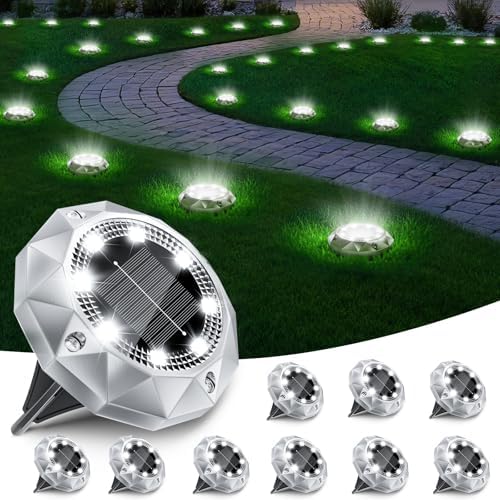

Create a Brighter, Safer and More Energy-Efficient Outdoor Space
Welcome to Elemon.co.uk — Products of Tomorrow… Today.
Outdoor lighting has evolved dramatically over the last few years. What was once considered a decorative luxury has become an essential part of modern home design, helping homeowners improve safety, security, energy efficiency and the overall appearance of their gardens.
Thanks to significant improvements in solar technology, today’s garden lighting systems are brighter, smarter and far more reliable than early-generation solar lights. Premium monocrystalline solar panels, intelligent battery management systems and efficient LED technology now allow many fixtures to perform throughout the night—even during Britain’s unpredictable weather.
However, buying quality solar lights is only half of the equation.
The biggest difference between a solar lighting system that performs beautifully and one that disappoints usually comes down to where the lights are installed.
A poorly positioned £80 solar spotlight can perform worse than a correctly installed £20 model.
This guide explains how to create an effective solar lighting placement map for your property, helping you maximise sunlight collection while creating a professional-looking landscape that remains attractive throughout every season.
Whether you’re illuminating a compact courtyard, a suburban family garden or a large country property, these placement strategies will help you get the very best from every solar-powered fixture.
Why Planning Matters More Than Buying Expensive Lights
Many homeowners believe brighter lights automatically produce better results.
In reality, the performance of every solar light depends on one simple factor:
The amount of energy collected during daylight determines the amount of light available after sunset.
Solar lights cannot create electricity.
They simply store whatever energy they manage to collect during the day.
Poor positioning leads to:
- Short operating times
- Weak brightness
- Inconsistent performance
- Faster battery wear
- Frequent replacements
Meanwhile, a properly planned garden lighting layout offers:
- Longer illumination
- Better reliability
- Greater security
- Lower maintenance
- Reduced replacement costs
- Professional landscape aesthetics
Understanding How Solar Garden Lights Actually Work
Every solar garden light contains four primary components:
Solar Panel
Captures sunlight and converts it into electricity.
Modern premium lights use monocrystalline photovoltaic cells, which offer significantly better efficiency than older polycrystalline alternatives.
Rechargeable Battery
Stores the electricity collected throughout the day.
Most premium models now use:
- Lithium-Ion
- Lithium Iron Phosphate (LiFePO₄)
These batteries:
- last longer
- tolerate temperature changes better
- charge faster
- provide more stable output
LED Light Source
High-efficiency LEDs convert stored electrical energy into light.
Modern LEDs consume very little power while producing impressive brightness.
Typical outputs include:
| Light Type | Typical Brightness |
|---|---|
| Decorative lights | 5–20 lumens |
| Path lighting | 20–80 lumens |
| Garden spotlights | 100–300 lumens |
| Security lighting | 500–1200+ lumens |
Intelligent Controller
The controller automatically manages:
- charging
- battery protection
- dusk activation
- dawn shutdown
- motion detection
- brightness adjustment
Higher-quality controllers also optimise battery life by reducing output as battery levels decrease.
The UK’s Unique Solar Challenges
Designing solar lighting for the UK differs significantly from designing systems in Southern Europe or North America.
British gardens face several environmental challenges:
- frequent cloud cover
- shorter winter days
- low winter sun angles
- rain
- frost
- tree cover
- neighbouring buildings
- fences
- garden walls
This means positioning is considerably more important than absolute panel size.
A slightly smaller panel in full sunlight will often outperform a much larger panel installed in partial shade.
Step One: Understand Your Garden’s Sunlight
Before purchasing any lights, spend one sunny day observing how sunlight moves around your property.
Create a simple sketch of your garden.
Mark:
- house
- fences
- sheds
- garages
- trees
- pergolas
- walls
- patios
- decking
- flower beds
- pathways
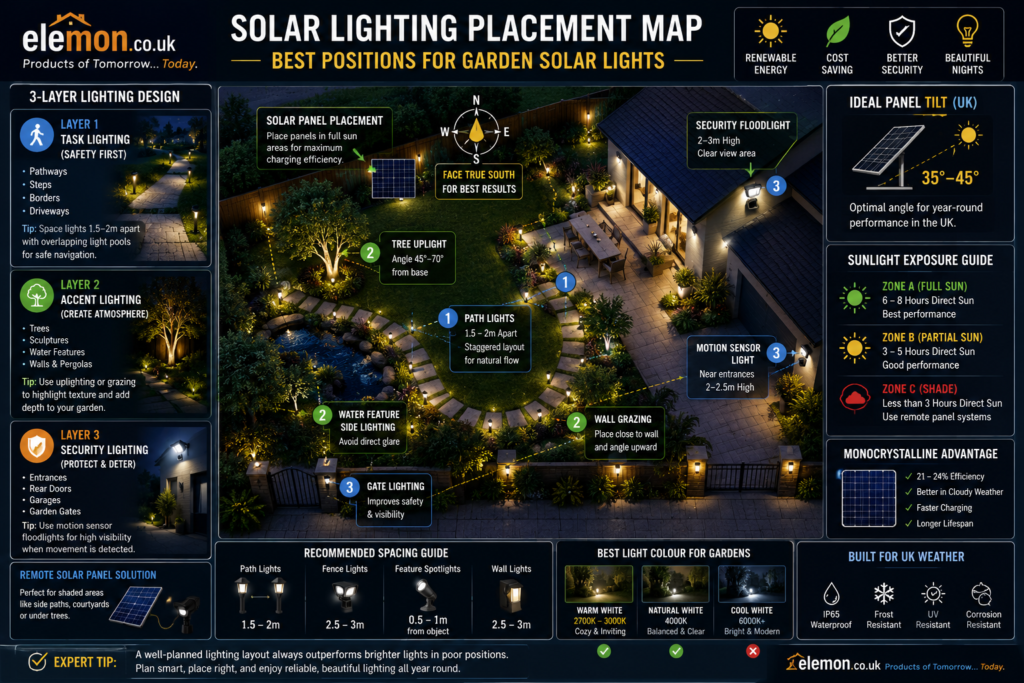
Then divide the garden into three sunlight zones.
Zone A – Full Sun
These areas receive:
6–8 hours of direct sunlight
Ideal locations include:
- open lawns
- south-facing fences
- patio edges
- raised beds
- garage roofs
These become your primary solar harvesting areas.
Zone B – Partial Sun
Receives:
3–5 hours of sunlight
Suitable for:
- decorative lights
- fence lighting
- feature illumination
Performance remains good with quality monocrystalline panels.
Zone C – Heavy Shade
Receives:
Less than 3 hours of direct sunlight.
Examples include:
- north-facing passages
- under dense trees
- beside garages
- narrow side paths
Integrated solar lights rarely perform well here.
Instead, consider models with remote solar panels.
Understanding Solar Panel Direction
One of the biggest mistakes homeowners make is ignoring compass direction.
Solar panels collect maximum energy when facing the correct direction.
For UK gardens:
| Direction | Performance |
|---|---|
| South | ★★★★★ |
| South-East | ★★★★☆ |
| South-West | ★★★★☆ |
| East | ★★★☆☆ |
| West | ★★★☆☆ |
| North-East | ★★☆☆☆ |
| North-West | ★★☆☆☆ |
| North | ★☆☆☆☆ |
South-facing positions receive the longest period of direct sunlight throughout the year.
Why North-Facing Installations Perform Poorly
Many fence lights are installed simply because they “look nice” on a particular wall.
Unfortunately, aesthetics alone don’t generate electricity.
North-facing installations often receive:
- indirect light only
- prolonged shade
- reduced winter charging
The result is:
- shorter runtime
- weaker brightness
- reduced battery lifespan
Whenever possible, install solar collectors where they have clear access to southern skies.
Understanding Seasonal Sun Movement
The sun’s path changes dramatically throughout the year.
Summer
- higher in the sky
- longer daylight
- easier charging
- maximum battery capacity
Winter
- much lower angle
- shorter days
- weaker sunlight
- longer shadows
This is why many solar lights appear excellent during July but struggle by December.
Planning for winter ensures reliable year-round performance.
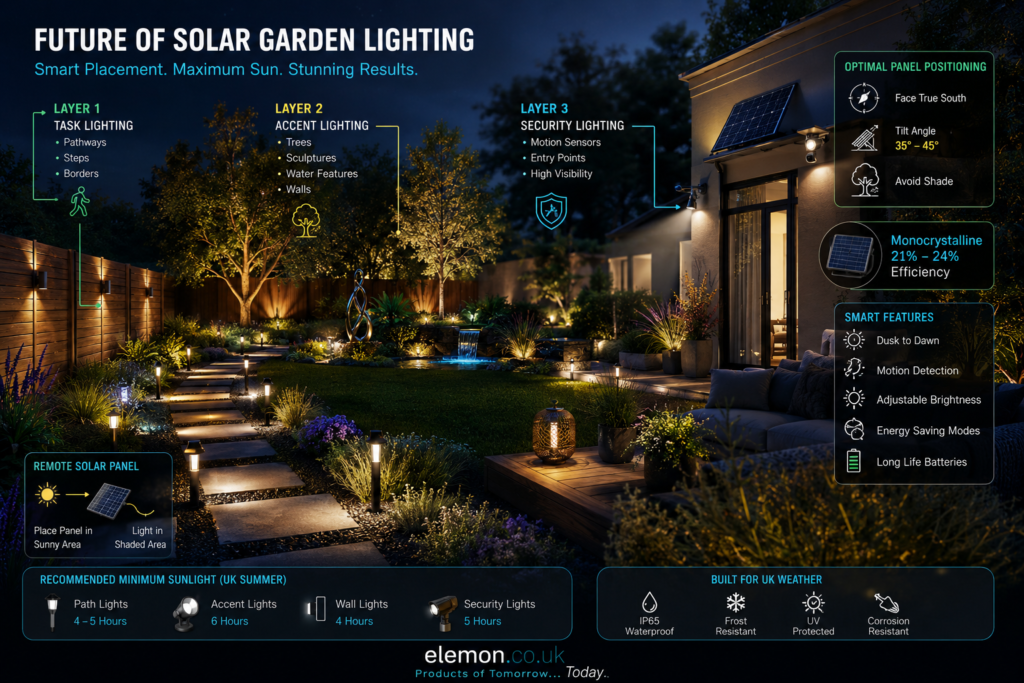
Choosing Monocrystalline Panels
Not all solar panels are equal.
Modern premium garden lights almost always use monocrystalline solar cells.
Advantages include:
✔ Higher efficiency
✔ Better cloudy-weather performance
✔ Smaller panel size
✔ Faster charging
✔ Longer lifespan
✔ Better winter performance
Polycrystalline panels remain available in many low-cost products but generally perform less efficiently in typical UK conditions.
Designing Your Garden in Lighting Layers
Professional landscape designers rarely rely on one type of lighting.
Instead, they create depth by combining several lighting layers.
These include:
          SECURITY
      ▲ Motion Floodlights

      AMBIENT LIGHTING
 Fence Lights • Wall Lights

      FEATURE LIGHTING
 Trees • Statues • Water Features

      PATH LIGHTING
 Walkways • Steps • Borders
Layering creates gardens that feel larger, safer and considerably more luxurious after dark.
Layer One – Pathway Lighting
Path lighting provides safe movement around the garden.
Common installation areas include:
- driveways
- gravel paths
- paving
- stepping stones
- decking
- entrances
The objective is gentle guidance—not airport runway brightness.
Instead of placing lights directly opposite one another, alternate positions from side to side.
This creates a softer appearance while reducing harsh shadows.
Recommended Spacing
General guideline:
1.5–2 metres apart
The light pools should gently overlap.
Too close:
- wasted energy
- excessive brightness
Too far apart:
- dark gaps
- trip hazards
- inconsistent appearance
Avoid the “Runway Effect”
One of the easiest ways to make a garden look artificial is by placing identical lights in perfectly straight lines.
Professional designers instead use subtle staggering.
Example:
Path Edge

●         ●          ●

      ●          ●

●         ●          ●
This naturally guides the eye while creating a much more relaxed landscape design.
Layer Two – Feature Lighting That Brings Your Garden to Life
Once pathways are safely illuminated, the next layer focuses on creating atmosphere.
Feature lighting highlights the elements that make your garden unique, adding depth, texture and visual interest after dark. Rather than flooding the entire space with bright light, carefully placed solar spotlights draw attention to selected features while leaving surrounding areas softly illuminated.
Well-positioned feature lighting can make even a modest garden feel larger, more inviting and professionally designed.
Ideal features include:
- Mature trees
- Garden sculptures
- Water features
- Pergolas
- Raised planters
- Stone walls
- Brickwork
- Decorative fencing
- Outdoor seating areas
Highlight Trees Using Uplighting
Trees are among the most effective landscape features to illuminate.
Position a solar spotlight approximately 50–100cm away from the trunk and angle the beam upwards between 45° and 70°.
This creates dramatic shadows within the branches and adds depth to the surrounding landscape.
Different tree types create different effects:
| Tree Type | Recommended Lighting |
|---|---|
| Silver Birch | Narrow spotlight highlighting bark texture |
| Olive Tree | Warm white uplighting through the canopy |
| Japanese Maple | Wide beam to enhance leaf colour |
| Palm Trees | Multiple low-angle spotlights |
| Evergreen Trees | Soft floodlighting from two sides |
Warm white LEDs (around 2700K–3000K) usually produce the most natural appearance.
Highlight Garden Walls
Brick and stone walls become beautiful design features when illuminated correctly.
Instead of pointing the light directly at the centre of the wall, place the spotlight close to the surface and angle it upwards.
This technique—known as wall grazing—emphasises texture, creating attractive shadows that reveal the natural detail of stone, brick and timber.
Perfect for:
- Natural stone walls
- Brick garden walls
- Timber fencing
- Decorative cladding
- Raised flower beds
Illuminate Pergolas and Seating Areas
Outdoor seating areas benefit from gentle ambient lighting rather than harsh security lighting.
Good options include:
- Solar string lights
- Solar lanterns
- Hanging solar bulbs
- Solar wall sconces
- Integrated deck lighting
Aim for a warm, welcoming atmosphere rather than maximum brightness.
A combination of overhead lighting and subtle floor illumination produces the most balanced effect.
Water Features
Moving water reflects light beautifully.
Position spotlights slightly to the side rather than directly in front.
This avoids glare while highlighting:
- fountains
- ponds
- waterfalls
- streams
- decorative bowls
Always ensure nearby solar panels remain clear of splashing water and overhanging vegetation.
Layer Three – Security Lighting
Security lighting has a different purpose.
Rather than creating atmosphere, it should improve visibility around vulnerable areas while discouraging unwanted visitors.
Key locations include:
- Rear doors
- Side entrances
- Garages
- Garden gates
- Tool sheds
- Bicycle storage
- Bin storage
- Driveways
Modern solar security lights typically include:
- PIR motion sensors
- Adjustable brightness
- Adjustable timer
- Detection range settings
- Low-power standby mode
Many premium models remain at approximately 20–30 lumens before increasing to 500–1200 lumens when movement is detected.
This greatly extends battery life.
Recommended Security Mounting Heights
Correct mounting height significantly improves sensor performance.
| Installation Area | Recommended Height |
|---|---|
| Side entrance | 2–2.5m |
| Garage | 2.5–3m |
| Garden gate | 2m |
| Rear door | 2.2m |
| Shed | 2m |
Avoid mounting directly beneath roof overhangs where shadows can reduce charging efficiency.
Remote Solar Panels – The Secret to Difficult Gardens
Many UK gardens contain areas that simply never receive enough direct sunlight.
Examples include:
- Narrow side passages
- North-facing fences
- Areas beneath mature trees
- Courtyards
- High-walled gardens
Traditional integrated solar lights often struggle in these locations.
Instead, choose models with detachable solar panels.
These systems connect the light to a remote panel using a weatherproof cable, allowing the panel to be installed in a much sunnier location while the light remains exactly where it’s needed.
 SOUTH-FACING FENCE

 ☀️ Sun

      [ Solar Panel ]
             │
             │ Weatherproof Cable
             │
             ▼

============================

      Shaded Side Path

        ● Solar Light
This simple solution dramatically improves charging performance.
Understanding Solar Panel Tilt
Panel angle affects how much sunlight reaches the photovoltaic cells.
For most UK gardens:
| Season | Recommended Tilt |
|---|---|
| Summer | 25–35° |
| Spring / Autumn | 35–40° |
| Winter | 40–50° |
Many premium lights feature adjustable brackets that allow seasonal optimisation.
A slightly steeper winter angle also helps rain wash away dirt and leaves.
Keep Panels Away From Shade
One small shadow can dramatically reduce charging efficiency.
Common sources include:
- Roof gutters
- Chimneys
- Trees
- Bushes
- Garden furniture
- Pergolas
- Washing lines
- Satellite dishes
Remember:
Morning shade may be acceptable.
Midday shade should be avoided whenever possible.
Avoid Tree Canopies
One of the biggest mistakes homeowners make is placing solar lights beneath attractive trees.
Although the light itself may look perfect there, the solar panel spends much of the day beneath dense foliage.
Even deciduous trees become problematic once fully leafed during late spring.
Instead:
Place the panel in open sunlight and use a remote cable if necessary.
The Ideal Garden Lighting Layout
A professional lighting design normally combines several fixture types.
                HOUSE

────────────────────────────────

 Wall Lights      Wall Lights

       Patio

 Lanterns   Seating   Lanterns

────────── Lawn ──────────

   Tree           Tree

 Spotlight     Spotlight

──────── Pathway ────────

●       ●      ●      ●

──────── Fence ─────────

 Fence Lights Every 3m

Motion Light      Motion Light

      Rear Gate
This layered arrangement creates:
- Safe navigation
- Better security
- Attractive landscaping
- Balanced brightness
- Minimal energy waste
Best Placement for Different Garden Sizes
Small Gardens
Focus on:
- Path lighting
- One feature tree
- Fence lighting
- Rear security light
Avoid installing too many lights.
Less often creates a more premium appearance.
Medium Gardens
Combine:
- Path lights
- Accent spotlights
- Deck lighting
- Wall lighting
- Security floodlights
Aim for several lighting layers.
Large Gardens
Divide the space into zones.
For example:
Zone 1
Entrance
Zone 2
Patio
Zone 3
Feature planting
Zone 4
Walkways
Zone 5
Security perimeter
This approach improves maintenance and future upgrades.
Common Placement Mistakes
Avoid these frequent installation errors:
Installing Too Many Lights
More fixtures don’t necessarily create a better garden.
Excessive lighting causes glare and reduces visual contrast.
Ignoring Maintenance Access
Leave enough space to:
- clean panels
- trim nearby plants
- replace batteries if required
- adjust fittings
Mixing Colour Temperatures
Avoid combining cool white and warm white lighting within the same area.
Consistency creates a far more elegant finish.
Forgetting Seasonal Growth
That small shrub beside today’s light may become a large bush within two years.
Allow enough clearance for future plant growth.
Choosing Appearance Over Performance
The most attractive installation location isn’t always the most efficient.
Always prioritise sunlight exposure first.
Professional Installation Checklist
Before fixing any solar light permanently, confirm:
✔ Panels receive direct sunlight.
✔ No permanent shade between 10am and 3pm.
✔ Lights are level.
✔ Mounting brackets are secure.
✔ PIR sensors have a clear detection zone.
✔ Panels face the best available direction.
✔ Fixtures remain accessible for cleaning.
✔ Batteries can be serviced where applicable.
Seasonal Maintenance Calendar
Even the highest-quality solar lighting system requires occasional maintenance to perform at its best. Fortunately, keeping your lights in top condition takes very little time.
By following a simple maintenance schedule, you can maximise battery life, maintain brightness and extend the lifespan of your outdoor lighting.
| Season | Recommended Tasks |
|---|---|
| Spring | Clean solar panels, inspect brackets, trim nearby plants, test all fixtures after winter. |
| Summer | Remove dust and pollen, check battery performance, reposition lights if new landscaping creates shade. |
| Autumn | Clear fallen leaves regularly, tighten fixings, clean lenses and prepare panels for lower winter sunlight. |
| Winter | Remove snow, frost and heavy dirt, wipe panels after storms, inspect waterproof seals and ensure drainage remains clear. |
Even a thin layer of dirt can noticeably reduce charging performance, particularly during the shorter winter days.
Cleaning Solar Panels Correctly
One of the easiest ways to improve performance is simply keeping the solar panels clean.
Recommended Equipment
- Soft microfibre cloth
- Warm water
- Mild soap (if necessary)
- Soft brush for stubborn dirt
Avoid:
- Abrasive cleaning pads
- Pressure washers
- Solvents
- Bleach
- Glass polishing compounds
Scratched solar panels collect less sunlight and may permanently lose efficiency.
Looking After Rechargeable Batteries
Rechargeable batteries naturally lose capacity over time.
Most premium garden lights use:
- Lithium-Ion
- Lithium Iron Phosphate (LiFePO₄)
Typical battery lifespan:
| Battery Type | Average Lifespan |
|---|---|
| NiMH | 2–3 years |
| Lithium-Ion | 4–6 years |
| LiFePO₄ | 6–10 years |
If your lights become noticeably dim after several years despite good sunlight exposure, replacing the battery may restore full performance.
Understanding IP Ratings
Outdoor lighting should always be suitable for the British climate.
The Ingress Protection (IP) rating indicates resistance to dust and water.
| Rating | Suitable For |
|---|---|
| IP44 | Sheltered patios only |
| IP54 | Light rain exposure |
| IP65 | Most UK gardens |
| IP66 | Heavy rain and exposed locations |
| IP67 | Temporary water immersion |
| IP68 | Permanent underwater use |
For most homeowners, IP65 provides the ideal balance between durability and cost.
Choosing the Right Solar Light for Each Area
Not every solar light is designed for the same purpose.
Matching the correct fixture to the location improves both appearance and efficiency.
| Garden Area | Recommended Solar Light |
|---|---|
| Front path | Low-level path lights |
| Driveway | Bright bollard lights |
| Decking | Recessed deck lights |
| Pergola | Hanging lanterns or string lights |
| Flower beds | Adjustable spotlights |
| Trees | Narrow beam uplights |
| Garden walls | Wall washers |
| Fence | Decorative fence lights |
| Patio | Warm white ambient lighting |
| Rear entrance | Motion-sensor floodlight |
Smart Features Worth Considering in 2026
Modern solar lighting has become significantly more advanced than earlier generations.
Features worth looking for include:
- Automatic dusk-to-dawn operation
- Motion detection
- Adjustable brightness levels
- Remote solar panels
- USB emergency charging
- Colour temperature selection
- Smartphone connectivity (selected models)
- Timer modes
- Adaptive brightness control
- Battery health monitoring
Although not essential for every installation, these features can improve both convenience and efficiency.
My Experience: At Elemon.co.uk, we’ve found that homeowners often focus on purchasing the brightest or most expensive solar lights while overlooking the importance of planning. In practice, a thoughtfully designed layout almost always delivers better results than simply increasing brightness.
The most successful gardens typically combine three key principles:
- Maximise sunlight collection.
- Use different lighting layers for different purposes.
- Maintain the system regularly.
We’ve also seen how remote-panel solar lights can transform shaded spaces such as narrow side passages and enclosed courtyards, making areas that once felt unusable after dark both practical and welcoming. A small amount of planning before installation can save both time and money while producing a far more professional finish.
Frequently Asked Questions
Do solar lights work during cloudy UK weather?
Yes.
Modern monocrystalline panels continue to generate electricity under overcast conditions, although charging efficiency is naturally reduced compared with bright sunshine.
How many hours of sunlight do solar lights need?
Most quality models perform best with 4–6 hours of direct sunlight each day.
Decorative lights may require less, while brighter security lights generally benefit from longer charging periods.
Should solar panels face south?
Where practical, yes.
A south-facing orientation usually provides the highest energy collection throughout the year in the UK.
If this isn’t possible, south-east or south-west positions are good alternatives.
Can solar lights stay outside during winter?
Quality outdoor lights designed with suitable IP ratings are intended to remain outdoors year-round.
Regular cleaning and occasional inspections help maintain reliable performance during colder months.
Are remote solar panels worth buying?
Absolutely—particularly for shaded gardens.
They allow the solar panel to be positioned in full sunlight while the light itself remains exactly where illumination is needed.
Key Takeaways
✔ Plan your lighting layout before buying fixtures.
✔ Prioritise sunlight exposure over appearance.
✔ Choose monocrystalline solar panels whenever possible.
✔ Layer pathway, feature and security lighting for the best visual effect.
✔ Keep panels clean throughout the year.
✔ Use remote-panel systems in shaded areas.
✔ Select fixtures with an IP65 rating or higher for exposed garden locations.
✔ Check for seasonal shading caused by trees and buildings.
✔ Match the brightness of each light to its intended purpose.
✔ Review your layout each year as your garden grows and changes.
UK Safety Considerations
While solar lighting avoids the need for mains electrical wiring in many situations, it’s still important to install fixtures safely.
- Ensure lights do not create trip hazards along pathways.
- Secure wall-mounted fittings firmly using suitable fixings.
- Avoid installing lights where they could obstruct doors, gates or emergency exits.
- Follow the manufacturer’s installation instructions.
- Use appropriate ladders and personal protective equipment when mounting lights at height.
- If combining solar lighting with mains-powered outdoor electrical systems, consult a qualified electrician where required.
Final Thoughts
A well-designed solar lighting layout does far more than illuminate a garden.
It creates atmosphere, improves safety, enhances security and transforms outdoor spaces into places you’ll enjoy long after sunset—all without increasing your electricity bill.
By understanding how sunlight moves across your property, selecting quality equipment and positioning each fixture with purpose, you can achieve professional-looking results that continue to perform throughout the changing British seasons.
Solar technology continues to improve year after year, making it easier than ever to create sustainable, low-maintenance outdoor lighting that looks impressive while reducing energy consumption.
Whether you’re upgrading a small patio, redesigning an entire landscape or simply adding a few lights to improve visibility, thoughtful planning remains the key to long-term success.
At Elemon.co.uk, we’re passionate about helping homeowners discover practical technologies that make everyday living smarter, safer and more efficient.
Products of Tomorrow… Today.
Related Articles on Elemon.co.uk
- Solar vs Wired Garden Lights – Which Is Right for Your Garden?
- Smart Thermostat Calibration Guide
- DIY Smart Security Setup
- LED Strip Power Calculator
- Smart Home Wall Panel Guide
- Outdoor Smart Lighting Ideas for Every Garden
- Best Budget Solar Security Lights in the UK
- How to Design an Energy-Efficient Garden
Affiliate Disclaimer: Some articles on Elemon.co.uk contain affiliate links “amazon associate“. If you purchase products through these links, we may earn a small commission at no additional cost to you. This helps support our independent reviews, buying guides and DIY content. We only recommend products we believe offer genuine value to our readers.