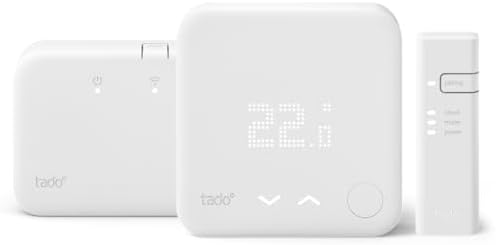

Smart Thermostat Calibration Guide: How to Optimise Heating Efficiency in UK Homes
For many UK homeowners, a smart thermostat is one of the first upgrades made when trying to reduce household energy bills. Yet after installation, most people leave every setting exactly as it was configured by default.
That is where the biggest opportunity is often missed.
Modern smart heating systems are capable of far more than simply switching your boiler on and off. When properly calibrated, they can learn how your property warms up, communicate more intelligently with compatible boilers, optimise heating schedules around your lifestyle, and reduce unnecessary fuel consumption without sacrificing comfort.
Whether you live in a Victorian terrace in Manchester, a 1930s semi-detached house in Birmingham, a countryside cottage in Yorkshire, or a highly insulated new-build in Milton Keynes, your home’s heating characteristics are unique. A single factory configuration cannot accurately account for differences in insulation, radiator size, ceiling height, glazing, occupancy patterns, or local weather conditions.
The good news is that improving performance doesn’t usually require expensive upgrades. A few careful adjustments can often make your heating system noticeably more efficient while creating a more consistent indoor temperature throughout the day.
In this comprehensive Elemon.co.uk guide, we’ll explain how smart thermostat calibration works, why it matters, and how UK homeowners can fine-tune their heating systems for maximum comfort and efficiency.
My Experience: Over the past few years, smart heating technology has evolved from being a premium gadget into something that genuinely benefits everyday homeowners. One of the most common issues we’ve seen isn’t poor hardware—it’s poor configuration. Many people invest in an excellent smart thermostat, install it correctly, then assume the work is finished. Months later they wonder why:
- their heating still feels inconsistent
- some rooms are always too warm
- others remain cold
- the boiler seems to run constantly
- energy bills haven’t reduced as expected
In most cases, the thermostat itself isn’t the problem. It’s simply working with default assumptions rather than understanding how that particular house behaves. During our testing and research at Elemon.co.uk, we’ve found that homes with correctly calibrated heating schedules, accurate temperature sensors, balanced radiators and appropriate flow temperatures often experience:
- more stable indoor temperatures
- less boiler cycling
- improved comfort
- quieter operation
- reduced gas consumption
- longer boiler lifespan
The improvements aren’t always dramatic overnight, but over an entire heating season they can become surprisingly significant.
Why Smart Thermostat Calibration Matters
Installing a smart thermostat is only the beginning.
Calibration is what transforms it from an expensive timer into an intelligent heating management system.
Think of it like buying a professional DSLR camera.
Leaving every setting on Auto will produce decent photographs.
Learning how to adjust aperture, ISO and shutter speed produces exceptional ones.
Exactly the same principle applies to home heating.
Most factory settings are intentionally conservative because manufacturers must support thousands of different property types across multiple countries.
Your home isn’t average.
Neither is your family’s daily routine.
Calibration allows the thermostat to learn those differences.
Every Home Behaves Differently
No two homes lose heat at the same rate.
Several factors influence thermal performance:
- Wall construction
- Loft insulation
- Floor insulation
- Double or triple glazing
- Number of occupants
- Sunlight exposure
- Ceiling height
- Window size
- Building orientation
- Radiator output
- Boiler efficiency
- Pipe layout
A Victorian property built in 1890 behaves completely differently from a modern A-rated house completed in 2025.
Yet many thermostats begin with almost identical default assumptions.
Why Factory Settings Aren’t Perfect
Manufacturers design products to work safely in almost any installation.
That means the thermostat often assumes:
- average insulation
- average room size
- average heating response
- average radiator performance
- average outdoor climate
Unfortunately, British housing stock is anything but average.
According to housing surveys, millions of UK homes were constructed before modern insulation standards even existed.
This makes calibration particularly valuable.
Understanding How Smart Thermostats Actually Work
Traditional thermostats operated using a very simple principle.
Room temperature dropped.
Heating switched on.
Target temperature reached.
Heating switched off.
Although straightforward, this approach created several problems.
The Problem With Older Heating Controls
Conventional thermostats generally rely on simple relay switching.
The boiler fires at maximum output until the thermostat says stop.
The problem is that heating systems contain thermal momentum.
Even after the boiler stops:
- radiators remain hot
- pipework continues releasing heat
- walls absorb warmth
- furniture stores energy
The room temperature often continues rising after heating has stopped.
This is called temperature overshoot.
Overshooting creates:
- unnecessary fuel usage
- uncomfortable temperature swings
- increased boiler cycling
- reduced efficiency
How Smart Thermostats Improve Heating
Modern smart thermostats use algorithms rather than simple switches.
Instead of only asking:
“Is the room cold?”
they also consider:
- how quickly temperatures rise
- outside weather
- historical heating performance
- occupancy
- daily schedules
- humidity
- previous heating cycles
- boiler response times
Some systems even learn your home’s thermal behaviour over several weeks.
The result is much smoother temperature control.
Why Boiler Cycling Costs Money
One of the biggest hidden inefficiencies in many homes is excessive boiler cycling.
Cycling refers to how frequently the boiler starts and stops.
Frequent starts create:
- ignition wear
- reduced combustion efficiency
- increased gas consumption
- unnecessary mechanical stress
Imagine driving a car in city traffic.
Accelerate.
Brake.
Accelerate.
Brake.
Fuel economy suffers.
Boilers experience something very similar.
A well-calibrated smart thermostat aims to reduce unnecessary cycling while maintaining comfort.
OpenTherm vs Traditional Relay Heating
Understanding how your thermostat communicates with your boiler is one of the most important parts of optimisation.
There are two common approaches.
OpenTherm (Digital Modulation)
OpenTherm is considered one of the most efficient communication methods available.
Rather than simply telling the boiler to switch fully on or fully off, it continuously exchanges digital information.
Instead of saying:
“Heat the house.”
It says:
“Heat gently.”
or
“Increase water temperature slightly.”
or
“Reduce burner output.”
This allows the boiler to operate at lower flame levels for longer periods.
Benefits include:
- smoother temperatures
- quieter operation
- reduced cycling
- improved condensing efficiency
- lower fuel usage
- increased component lifespan
Many newer boilers support OpenTherm either as standard or with optional modules.
Traditional Relay (On/Off)
Older systems generally use a simple relay.
The thermostat either:
ON
or
OFF.
Nothing in between.
These systems still work well but require more careful scheduling and calibration because the boiler cannot gradually adjust output.
Fortunately, modern smart thermostats compensate using intelligent software.
What is TPI?
Many UK smart thermostats use Time Proportional and Integral (TPI) control.
Rather than continuously running the boiler, TPI decides exactly how long the boiler should operate within each hour.
For example:
Instead of:
Heating ON for 60 minutes
It may choose:
- ON for 12 minutes
- OFF for 8 minutes
- ON for 10 minutes
- OFF for 15 minutes
This greatly reduces temperature overshoot.
Properly configured TPI systems can feel almost as smooth as OpenTherm despite using traditional relay wiring.
Signs Your Smart Thermostat Needs Calibration
Many homeowners don’t realise their system is poorly calibrated.
Some common warning signs include:
Rooms Feel Too Hot
If your thermostat is set to 20°C but the room regularly reaches 22°C, the system is probably overshooting.
Heating Runs Constantly
A boiler operating almost continuously may indicate:
- incorrect flow temperatures
- poor sensor placement
- excessive heat loss
- scheduling problems
Some Rooms Never Warm Up
Uneven temperatures often point towards:
- unbalanced radiators
- incorrect TRV settings
- poor hydraulic flow
- sensor positioning
Large Daily Temperature Swings
If mornings feel freezing and evenings become uncomfortably warm, predictive heating settings may require adjustment.
Unexpectedly High Gas Bills
If usage hasn’t reduced after installing a smart thermostat, calibration should be one of the first areas to investigate.
Choosing the Best Location for Your Thermostat
Placement has a surprisingly large effect on accuracy.
Avoid installing a thermostat:
❌ Above radiators
❌ Behind curtains
❌ Near televisions
❌ In direct sunlight
❌ Next to fireplaces
❌ Beside exterior doors
❌ Close to kitchen appliances
❌ On cold external walls if possible
Instead, choose:
✔ Internal wall
✔ Around 1.5 metres from floor level
✔ Good airflow
✔ Frequently occupied room
✔ Away from direct heat sources
✔ Central position within the living space
Good placement alone can noticeably improve comfort before changing a single software setting.
Common Calibration Mistakes
At Elemon.co.uk we’ve found these mistakes repeatedly appear in UK homes:
Leaving Boiler Flow Temperature Too High
Many boilers remain permanently set to 75–80°C despite modern condensing technology working more efficiently at lower temperatures in suitable systems.
Ignoring Temperature Offset
Even premium thermostats can read slightly high or low depending on installation position.
Ignoring sensor calibration often creates noticeable comfort issues.
Heating Empty Rooms
Without zoned control, spare bedrooms, unused dining rooms and guest rooms may receive exactly the same heating as occupied spaces.
Constant Manual Adjustments
Frequently increasing and decreasing target temperatures prevents smart algorithms from learning occupancy patterns effectively.
Overcomplicated Schedules
Some homeowners create dozens of different temperature changes throughout the day.
Simpler schedules often perform better because predictive learning has more consistent data.
Benefits of Proper Calibration
When correctly configured, a smart heating system can deliver measurable improvements across comfort, efficiency and equipment longevity.
Potential benefits include:
| Benefit | Typical Improvement |
|---|---|
| Indoor comfort | ★★★★★ |
| Boiler efficiency | ★★★★☆ |
| Temperature consistency | ★★★★★ |
| Fuel savings | ★★★★☆ |
| Reduced boiler cycling | ★★★★★ |
| Smart automation | ★★★★★ |
| Long-term maintenance | ★★★★☆ |
While actual savings vary depending on property type and heating habits, careful optimisation helps ensure your heating system works with your home rather than against it.
Step-by-Step Smart Thermostat Calibration
Now that you understand how smart heating systems work, it’s time to optimise your own setup.
Before making any adjustments, remember that every heating system is different. If you’re unsure about your boiler settings or controls, consult the manufacturer’s documentation or a qualified heating engineer.
The goal isn’t to make your heating hotter—it’s to make it smarter.
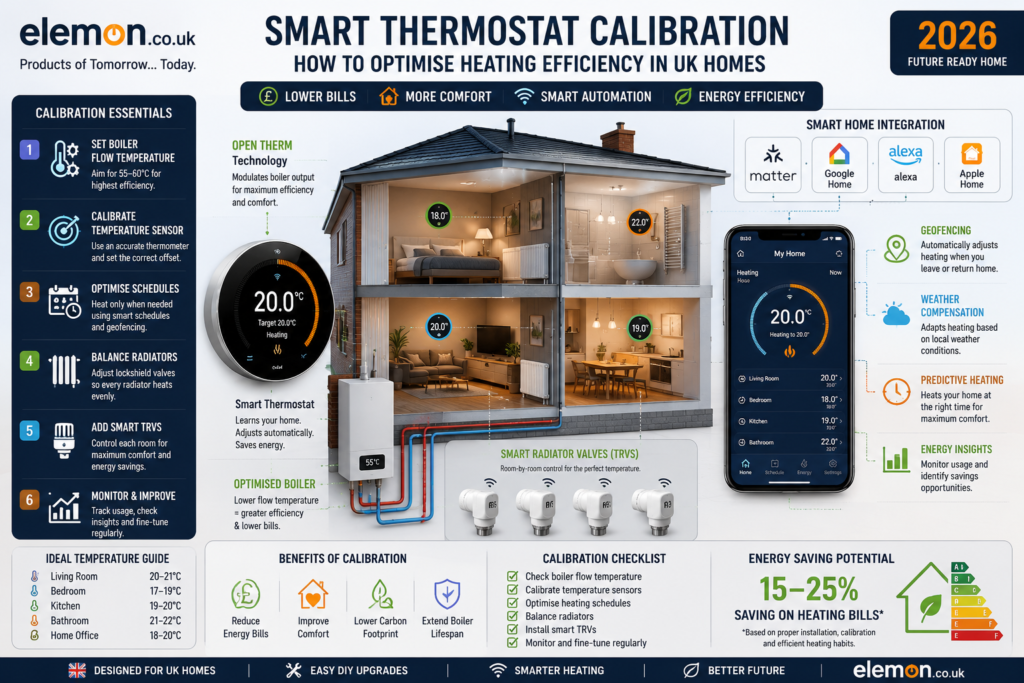
Step 1 – Check Your Boiler Settings
Your thermostat can only control what your boiler allows.
Many homeowners spend hundreds of pounds on smart controls while leaving their boiler configured exactly as it was installed years ago.
Start by identifying:
- Boiler manufacturer
- Boiler model
- Installation year
- Heating type
- Communication method
Common UK boiler brands include:
- Worcester Bosch
- Vaillant
- Ideal
- Baxi
- Viessmann
- Glow-worm
- Alpha
- Intergas
Many modern condensing boilers support digital modulation, although some require additional interface modules.
Is Your Boiler Using OpenTherm?
Look inside:
- installation paperwork
- installer menu
- thermostat wiring
- boiler manual
If OpenTherm is enabled, your thermostat controls boiler output dynamically.
If not, the thermostat will normally operate using relay switching with TPI control.
Both systems can be highly efficient when configured correctly.
Step 2 – Optimise Boiler Flow Temperature
One of the easiest improvements many homeowners can make is reviewing their boiler’s central heating flow temperature.
Historically, boilers were often left at:
75–80°C
This produced rapid heating but reduced condensing efficiency.
Many modern systems perform well at:
| Heating System | Suggested Flow Temperature* |
|---|---|
| Modern radiators | 55–60°C |
| Larger radiators | 50–55°C |
| Underfloor heating | 35–45°C |
| Older poorly insulated homes | 60–65°C |
*Always follow your boiler manufacturer’s guidance and ensure the system still heats your home adequately.
Lower flow temperatures allow condensing boilers to spend more time operating efficiently, particularly during milder weather.
Step 3 – Measure Actual Room Temperature
Your thermostat can only make good decisions if it measures temperature accurately.
Rather than relying solely on the built-in sensor, compare it with a quality digital thermometer.
How to Measure Properly
Place the thermometer:
- in the centre of the room
- approximately seating height
- away from windows
- away from radiators
- away from televisions
- away from direct sunlight
Leave it undisturbed for around 45–60 minutes while heating remains stable.
Then compare:
Thermostat reading
vs
Independent thermometer.
Step 4 – Apply Temperature Offset
Many premium thermostats include sensor calibration.
If your room actually measures:
19.4°C
but the thermostat reports:
20.5°C
you’ll probably feel colder than expected because heating stops too early.
Apply the correction inside your thermostat app.
Typical offsets range between:
±0.5°C
and
±2°C
Small adjustments often make a surprisingly noticeable difference.
Step 5 – Review Heating Schedules
One of the biggest mistakes homeowners make is creating dozens of complicated schedules.
Instead, think about how people actually use the house.
Example weekday schedule:
| Time | Target Temperature |
|---|---|
| 06:00 | 20°C |
| 08:30 | 17°C |
| 16:30 | 20°C |
| 22:30 | 17°C |
Rather than constantly heating an empty property, the thermostat maintains comfort only when needed.
Modern learning algorithms become much more effective with consistent routines.
Step 6 – Enable Learning Features
Premium smart thermostats include intelligent optimisation features.
Depending on your system, these may include:
- Early Start
- Adaptive Heating
- True Radiant
- Weather Compensation
- Learning Mode
- Eco Mode
- Smart Recovery
These features analyse previous heating cycles and gradually learn:
- how quickly your house warms up
- how fast it cools down
- how outdoor temperature affects performance
- seasonal changes
The result is smoother heating with less energy waste.
Understanding Heat Loss
Every building continuously loses heat.
The thermostat’s job is simply replacing that heat at the correct rate.
Heat escapes through:
- roof
- walls
- windows
- doors
- floors
- ventilation
- chimneys
- extractor fans
Older UK properties naturally lose heat faster than newer homes.
This is why identical thermostat settings often produce very different energy bills.
Radiator Balancing Explained
One of the most overlooked improvements has nothing to do with electronics.
It’s hydraulic balancing.
Imagine pouring water into three glasses connected by different sized pipes.
The easiest route fills first.
Exactly the same thing happens inside heating systems.
Without balancing:
Closest radiators become extremely hot.
Furthest radiators remain lukewarm.
The thermostat keeps demanding heat.
The boiler runs longer.
Gas consumption increases.
What is a Lockshield Valve?
Every radiator normally has two valves.
One controls temperature.
The other controls water flow.
The second valve is called the lockshield valve.
It allows installers to balance the system.
Once adjusted correctly, every radiator receives an appropriate amount of hot water.
Basic Radiator Balancing Process
A simplified balancing process usually follows this order:
- Turn heating off.
- Allow radiators to cool.
- Open all thermostatic valves fully.
- Start heating.
- Begin adjusting lockshield valves.
Generally:
Closest radiator
↓
Less flow
Middle radiators
↓
Medium flow
Furthest radiator
↓
Most flow
The aim is for every radiator to warm at a similar rate.
Proper balancing improves comfort throughout the house.
Smart Thermostatic Radiator Valves (TRVs)
A central thermostat only measures one location.
That can create problems.
Imagine:
Living room
20°C
Bedroom
17°C
Office
23°C
Hallway thermostat
20°C
The thermostat believes everything is perfect.
It has no idea the rest of the property feels completely different.
Smart TRVs solve this problem.
Benefits of Smart TRVs
Instead of heating the whole house equally, each room becomes an independent heating zone.
Examples:
Bedroom
18°C
Living room
21°C
Office
20°C
Bathroom
22°C
Guest room
16°C
This targeted heating often improves comfort while reducing overall energy consumption.
Building a Zoned Heating System
For many UK homes, the ideal upgrade path is:
Boiler
↓
Smart Thermostat
↓
Smart TRVs
↓
Automation Platform
↓
Local Control
↓
Energy Monitoring
Each layer increases efficiency.
Optimising TPI Settings
If your system uses relay control rather than OpenTherm, TPI configuration becomes more important.
Cycles per hour determine how frequently the thermostat switches the boiler.
General guidance:
| Heating Type | Typical Cycles Per Hour |
|---|---|
| Standard gas radiators | 6 |
| Cast iron radiators | 3 |
| Electric heating | 9–12 |
| Underfloor heating | Lower, depending on system design |
Always follow manufacturer recommendations before making installer-level changes.
Weather Compensation
Some smart systems automatically consider outside temperature.
Instead of producing identical heating every day, they adjust based on weather conditions.
Cold winter morning:
Higher heating demand.
Mild autumn afternoon:
Reduced boiler output.
This prevents unnecessary overheating.
Geofencing
Location-based automation has become one of the most useful smart heating features.
Instead of following fixed schedules alone, the system also monitors whether occupants are home.
Typical behaviour:
Everyone leaves.
↓
Heating automatically reduces.
↓
Someone returns.
↓
Heating resumes before arrival.
This avoids heating an empty house for hours.
Adjust Geofencing Carefully
Avoid setting the radius too small.
If your commute takes:
45 minutes
but geofencing activates only 100 metres from home,
the house won’t have enough time to warm up.
Choose a distance that reflects your typical travel time.
Open Window Detection
Modern thermostats and TRVs can detect rapid temperature drops.
Instead of heating the outdoors, they temporarily pause heating.
Typical situations include:
- opening bedroom windows
- kitchen ventilation
- bathroom extractor use
- patio doors left open
This simple feature can prevent considerable energy waste.
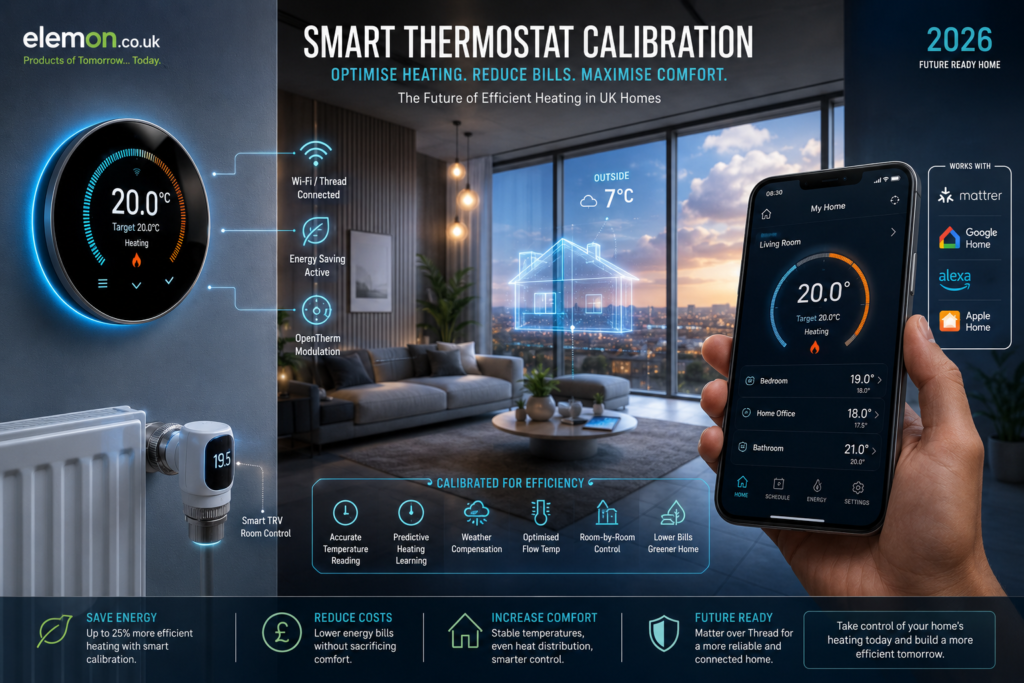
Smart Home Integration
Today’s heating systems rarely operate alone.
Many integrate with wider smart home ecosystems.
Examples include:
- lighting
- occupancy sensors
- window sensors
- weather stations
- smart blinds
- security systems
These integrations allow heating to react automatically to changing household conditions.
Matter: The Future of Smart Homes
Matter is becoming the universal communication standard for smart devices.
Rather than relying on separate ecosystems, compatible products work together more easily.
Benefits include:
- easier setup
- wider compatibility
- improved reliability
- reduced cloud dependence
- local automation
- faster response times
For homeowners planning future upgrades, Matter-compatible devices offer greater long-term flexibility.
Home Assistant Integration
Enthusiasts often use Home Assistant to create highly customised automations.
Examples include:
If:
Window opens
↓
Heating pauses
If:
Solar panels producing surplus electricity
↓
Heat pump increases operation
If:
Nobody home
↓
Reduce heating automatically
These local automations continue operating even if the internet connection is unavailable.
Energy Monitoring
Calibration becomes much easier when you can measure results.
Useful metrics include:
- daily gas consumption
- boiler runtime
- average room temperatures
- heating hours
- outside temperature
- occupancy
- flow temperature
- return temperature
Tracking trends over several weeks gives a much clearer picture than comparing individual days.
Seasonal Calibration
Heating systems shouldn’t remain identical all year.
Many homeowners benefit from reviewing settings:
Autumn
✔ Check schedules
✔ Test radiators
✔ Bleed trapped air
✔ Review boiler pressure
Winter
✔ Monitor energy usage
✔ Fine-tune comfort levels
✔ Check TRVs
Spring
✔ Reduce unnecessary schedules
✔ Review learning data
Summer
✔ Service boiler
✔ Update firmware
✔ Replace batteries
✔ Plan future upgrades
Advanced Optimisation Tips
After completing the basic calibration, consider these additional improvements:
- Bleed radiators annually.
- Keep furniture away from heat sources.
- Avoid covering radiators with curtains.
- Clean radiator fins where applicable.
- Maintain stable temperatures rather than large swings.
- Keep internal doors closed when zoning rooms.
- Regularly update thermostat firmware.
- Replace thermostat batteries before winter if applicable.
Small improvements combine to produce significant long-term gains.
Estimated Energy Saving Potential
Although every home differs, proper optimisation may contribute to reduced heating demand when combined with good insulation and sensible heating habits.
| Optimisation | Potential Benefit |
|---|---|
| Correct schedules | Up to 10% |
| Temperature calibration | Improved comfort & accuracy |
| Lower boiler flow temperature* | Higher condensing efficiency |
| Radiator balancing | More even heating |
| Smart TRVs | Reduced heating of unused rooms |
| Geofencing | Less wasted heating |
| Predictive learning | More efficient warm-up cycles |
*Only where suitable for your heating system and in accordance with the manufacturer’s recommendations.
Comparing Popular Smart Thermostat Ecosystems
Choosing the right smart thermostat is just as important as calibrating it correctly. While many products offer similar core functions, they differ in compatibility, smart home integration, installation requirements and long-term flexibility.
The table below compares some of the most popular systems available to UK homeowners.
| Feature | tado° X | Google Nest Learning Thermostat | Hive Thermostat Mini | Honeywell Home T6R |
|---|---|---|---|---|
| Best For | Maximum efficiency | Learning automation | Budget smart heating | Reliability |
| Boiler Compatibility | Excellent | Excellent | Very Good | Excellent |
| OpenTherm Support | Yes | Supported on compatible systems | Limited (model dependent) | Yes |
| Matter Support | Yes | Growing support | Limited | Limited |
| Smart TRV Ecosystem | Excellent | Third-party | Hive TRVs | Evohome compatible |
| Learning Features | Excellent | Excellent | Good | Good |
| Mobile App | Excellent | Excellent | Very Good | Very Good |
| DIY Installation | Moderate | Moderate | Easy | Moderate |
| Suitable for Heat Pumps | Selected systems | Selected systems | Limited | Selected systems |
Elemon Tip: Before purchasing any smart thermostat, always confirm compatibility with your existing boiler and heating controls. A premium thermostat cannot deliver its full potential if it isn’t supported by the heating system.
Estimated Energy Saving Opportunities
While every property is different, homeowners often achieve meaningful improvements by combining good insulation with proper heating optimisation.
| Upgrade | Estimated Benefit |
|---|---|
| Correct heating schedules | Lower unnecessary heating time |
| Accurate sensor calibration | More consistent comfort |
| Optimised boiler flow temperature | Improved condensing efficiency* |
| Smart TRVs | Better room-by-room control |
| Radiator balancing | More even heat distribution |
| Geofencing | Reduced heating when away |
| Weather compensation | Improved seasonal efficiency |
| Predictive learning | Smoother heating cycles |
*Only where appropriate for your boiler and heating system.
Remember that savings depend on factors such as:
- Property insulation
- Boiler efficiency
- Occupancy
- Outdoor temperatures
- Heating habits
- Fuel prices
Annual Smart Heating Maintenance Checklist
Even the smartest heating system benefits from regular maintenance.
Monthly
- Check thermostat batteries (if applicable)
- Review heating schedules
- Ensure Wi-Fi or Thread connectivity remains stable
- Check for firmware updates
- Monitor energy usage within the app
Every Three Months
- Clean thermostat housing
- Test temperature accuracy
- Check smart TRVs operate smoothly
- Inspect visible radiator valves
- Review automation routines
Annually
- Bleed radiators
- Check boiler pressure
- Arrange a professional boiler service
- Rebalance radiators if required
- Test safety devices
- Review flow temperature settings
- Update seasonal heating schedules
Common Smart Thermostat Problems
Heating Starts Too Early
Possible causes:
- Early Start enabled
- Incorrect learning data
- Schedule errors
Solution:
Allow the thermostat several weeks to learn, or reset its optimisation data if major changes have been made to the property.
Heating Never Reaches Target Temperature
Possible causes:
- Low boiler flow temperature
- Air trapped in radiators
- Poor balancing
- Incorrect sensor location
Boiler Constantly Switching On and Off
Possible causes:
- Poor TPI settings
- Oversized boiler
- Incorrect thermostat placement
- High temperature overshoot
One Room Always Too Warm
Possible causes:
- Smart TRV calibration
- Radiator balance
- Direct sunlight
- Internal heat sources
Poor Wi-Fi Connection
Possible causes:
- Weak signal
- Router location
- Building construction
- Network congestion
If available, Matter over Thread or local smart home hubs can improve reliability.
Future of Smart Heating
The next generation of home heating is moving beyond simple scheduling.
Over the coming years we expect to see wider adoption of:
- AI-assisted heating optimisation
- Local Matter automation
- Predictive weather-based control
- Smart heat pump integration
- Dynamic electricity tariff optimisation
- Occupancy sensing using multiple devices
- Whole-home energy management
- Solar battery integration
- Carbon footprint monitoring
- Machine-learning comfort profiles
Rather than simply reacting to temperature changes, future systems will increasingly predict heating demand before it occurs.
Frequently Asked Questions
Does a smart thermostat automatically reduce heating bills?
Not necessarily.
A smart thermostat provides the tools to improve efficiency, but the greatest benefits come from correct installation, calibration, sensible scheduling and good insulation.
Is OpenTherm better than relay control?
OpenTherm allows compatible boilers to modulate their output more precisely, which can improve efficiency and comfort.
However, well-configured relay systems with TPI control can also perform very effectively.
Should I lower my boiler flow temperature?
Many modern condensing boilers operate more efficiently at lower flow temperatures where suitable.
Always check your manufacturer’s recommendations and ensure your home still reaches comfortable temperatures.
Do smart radiator valves really help?
Yes.
Smart TRVs allow individual rooms to be heated according to occupancy, helping avoid wasting energy on unused spaces.
Is Matter worth considering?
If you’re building or upgrading a smart home, Matter-compatible devices offer better interoperability between manufacturers and are a strong choice for future expansion.
How often should I recalibrate my thermostat?
For most households:
- After installation
- After moving furniture
- Following insulation upgrades
- After replacing windows or doors
- If room temperatures consistently feel inaccurate
Otherwise, reviewing settings once or twice a year is usually sufficient.
Expert Tips from Elemon.co.uk
✔ Keep your thermostat in a frequently used room.
✔ Avoid large temperature changes throughout the day.
✔ Heat occupied rooms first.
✔ Don’t rely solely on the thermostat display—occasionally verify temperatures with an independent thermometer.
✔ Combine smart heating with loft insulation, draught proofing and efficient glazing for the best overall results.
✔ Review your schedules at the start of every heating season.
✔ Allow learning thermostats time to adapt before making constant manual adjustments.
Key Takeaways
- Smart thermostat calibration improves comfort as well as efficiency.
- Every UK property has unique heating characteristics.
- Correct boiler flow temperatures can improve condensing performance where appropriate.
- Sensor calibration helps maintain more accurate room temperatures.
- Radiator balancing remains one of the most overlooked efficiency improvements.
- Smart TRVs provide effective room-by-room temperature control.
- Predictive learning and weather compensation reduce unnecessary heating.
- Matter is becoming the future standard for smart home compatibility.
- Annual maintenance helps keep heating systems performing at their best.
- Small improvements made together can deliver noticeable long-term benefits.
Related Articles on Elemon.co.uk
Continue improving your smart home with these in-depth guides:
- Smart Home Wall Panel Guide – Building a Central Control Hub
- DIY Smart Security Setup – Cameras, Sensors and Automation Workflows
- LED Strip Power Calculator – Indoor & Outdoor Planning
- Smart Home Trends for 2026 and Beyond
- Solar vs Wired Garden Lights – Which Is Right for Your Garden?
- Smart Home Starter Guide for UK Homes
- Best Smart Thermostats for UK Homes
- DIY Heating Maintenance Checklist
- Smart Energy Saving Tips for Every Season
UK Safety Information
Working with heating controls is generally straightforward, but always prioritise safety.
- Never remove your boiler casing unless qualified to do so.
- Turn off electrical power before working on thermostat wiring.
- If you’re unsure whether your boiler supports OpenTherm, consult the installation manual or a Gas Safe registered engineer.
- Never attempt repairs to gas appliances yourself.
- Arrange annual servicing by a qualified professional to help maintain safe and efficient operation.
Affiliate Disclaimer: Some links on Elemon.co.uk may be affiliate links “amazon associate“. If you purchase a product through these links, we may earn a small commission at no additional cost to you. This helps support independent reviews, detailed buying guides and practical DIY content while allowing us to continue creating free resources for our readers.
Final Thoughts
A smart thermostat is far more than a convenient way to adjust your heating from your phone. When carefully calibrated, it becomes the control centre of a more efficient, comfortable and future-ready home.
Taking the time to optimise sensor accuracy, heating schedules, boiler settings and radiator performance can help your heating system respond more intelligently to your daily routine while avoiding unnecessary energy waste.
Whether you’re upgrading an older property or refining a modern smart home, thoughtful calibration is one of the most practical improvements you can make. Combined with regular maintenance and sensible energy habits, it helps create a home that is warmer when you need it, more efficient throughout the year and better prepared for the connected technologies of tomorrow.
At Elemon.co.uk, we’re committed to helping homeowners make informed technology choices through trusted reviews, practical DIY guides and expert advice—bringing you Products of Tomorrow… Today.