
Essential Tools Every Homeowner Should Own in 2026: The Complete UK DIY & Property Maintenance Guide
Welcome to Elemon.co.uk — Products of Tomorrow… Today.
Owning a home is one of life’s greatest achievements, but it also comes with an ongoing responsibility: keeping your property safe, functional, and looking its best. Whether you’ve just collected the keys to your first home, recently renovated your kitchen, or simply want to become more self-sufficient, investing in the right tools is one of the smartest financial decisions you can make.
For many homeowners across the UK, the first instinct when something breaks is to call a tradesperson. While professionals are essential for complex electrical, structural, or gas work, countless everyday repairs can be completed safely with the right equipment and a little knowledge.
At Elemon.co.uk, we believe modern DIY isn’t about replacing skilled tradespeople—it is about giving homeowners the confidence to solve everyday problems efficiently, safely, and economically. The right collection of tools doesn’t just save money; it gives you independence, improves your home’s value, and prepares you for unexpected situations.
In this comprehensive guide, we’ll explore the essential tools every UK homeowner should own in 2026, explain what makes a quality tool worth buying, and help you build a toolkit that will serve you for many years.
Why Every Homeowner Needs Their Own Toolkit
Many people underestimate how frequently basic tools are needed around the home.
A loose kitchen cupboard hinge.
A leaking outdoor tap.
A picture frame that needs hanging.
A shelf that requires levelling.
Flat-pack furniture waiting to be assembled.
Replacing smoke alarm batteries.
Adjusting internal doors.
Installing smart home devices.
These jobs appear throughout the year, often at inconvenient times. Calling someone out for every small repair quickly becomes expensive.
Today’s premium tools are also more affordable than ever before. Thanks to advances in manufacturing, battery technology, and improved materials, homeowners can now purchase professional-quality equipment without spending a fortune.
Instead of viewing tools as an expense, think of them as a long-term investment that continually pays for itself.
My Experience
Over the years, I’ve learned one lesson repeatedly: buying cheap tools almost always costs more in the long run. Like many homeowners, I started with an inexpensive toolkit that promised over 200 pieces. At first glance, it looked like incredible value. However, after only a handful of projects, screwdriver tips began to wear down, tape measures stopped retracting properly, and adjustable spanners developed excessive movement that made precision work frustrating. Eventually, I replaced nearly every item individually with better-quality alternatives. Looking back, I realised I would have spent considerably less money by purchasing fewer—but much higher-quality—tools from the beginning. Today, my toolkit is smaller, better organised, and capable of handling almost every maintenance task around my home.
That’s exactly the approach this guide follows.
Quality over quantity.
Reliability over gimmicks.
Long-term value over short-term savings.
The Modern Home Requires Modern Tools
Homes have changed dramatically over the past decade.
Traditional DIY has merged with technology.
Today’s homeowner may be installing:
- Smart thermostats
- Video doorbells
- Wi-Fi security cameras
- LED lighting systems
- Home automation hubs
- Solar-powered garden lighting
- Wireless sensors
- Smart locks
These products often require accurate drilling, precise measuring, cable management, and careful installation.
Modern tools make these jobs faster, cleaner, and significantly more accurate than older equipment.
The result is a smarter home installed with professional-looking results.
Affiliate Disclaimer: As an Amazon Associate, Elemon.co.uk earns from qualifying purchases. This comes at no extra cost to you and helps support our independent reviews and content.
Building Your Toolkit the Smart Way
One common mistake is attempting to purchase everything at once.
Instead, build your toolkit gradually.
Start with the tools you’ll genuinely use every month.
Then expand as your confidence and project complexity grow.
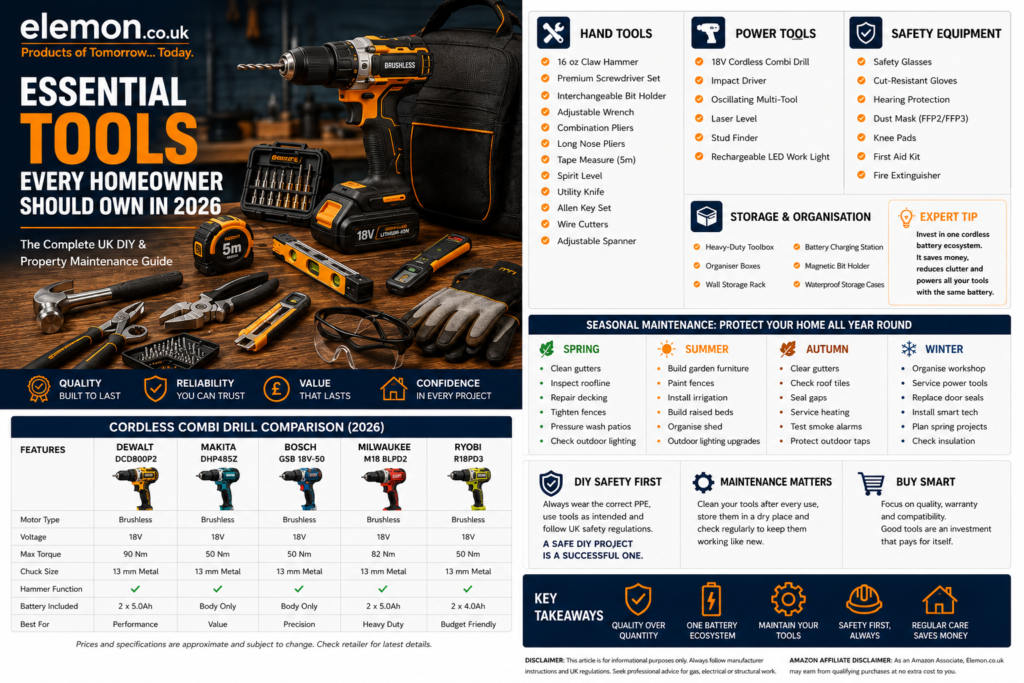
A sensible toolkit generally develops in four stages:
Stage 1 – Essential Hand Tools
Perfect for everyday household maintenance.
Stage 2 – Essential Power Tools
Ideal for repairs, furniture assembly and home improvements.
Stage 3 – Measuring & Precision Equipment
Designed to improve accuracy and save time.
Stage 4 – Specialist DIY Equipment
Useful once you begin larger renovation or garden projects.
Building your collection this way ensures every purchase delivers genuine value.
Essential Hand Tools Every Homeowner Should Own
Hand tools remain the foundation of every successful DIY project.
Even in an era of cordless power tools and smart technology, these traditional tools remain indispensable.
1. Claw Hammer
Every toolkit begins with a dependable hammer.
A quality 16 oz (450 g) claw hammer provides enough weight for most household tasks without becoming difficult to control.
Typical uses include:
- Hanging pictures
- Installing timber battens
- Furniture assembly
- Removing old nails
- Fence repairs
- Garden projects
What to Look For
✔ Forged steel head
✔ Fibreglass or steel handle
✔ Anti-slip grip
✔ Balanced weight distribution
Avoid extremely lightweight decorative hammers that struggle with tougher jobs.
2. Premium Screwdriver Set
Few tools are used more frequently than screwdrivers.
From replacing electrical faceplates (after isolating power safely) to tightening cabinet hinges, they are used almost weekly.
Instead of buying dozens of low-quality screwdrivers, choose a premium interchangeable bit system.
Essential bits include:
- Phillips (PH)
- Pozidriv (PZ)
- Flat-head
- Torx
- Hex
Magnetic bit holders make work considerably easier by reducing dropped screws.
A comfortable ergonomic handle also reduces fatigue during longer jobs.
3. Adjustable Wrench
Every homeowner eventually encounters plumbing fittings.
Radiator valves.
Outdoor taps.
Washing machine hoses.
Sink traps.
An adjustable wrench allows one tool to fit multiple nut sizes, reducing clutter while remaining highly versatile.
Look for:
- Smooth adjustment mechanism
- Laser measurement markings
- Hardened steel jaws
- Comfortable rubber grip
4. Combination Pliers
Pliers are among the most versatile tools in any workshop.
They can grip, twist, bend, hold, pull, and cut a wide variety of materials.
Useful jobs include:
- Removing damaged nails
- Holding small components
- Straightening wire
- Pulling wall plugs
- Installing fencing clips
- Cable work
Many modern versions also include integrated wire cutters.
5. Tape Measure
Nearly every DIY project begins with measuring.
The old saying remains true:
Measure twice. Cut once.
A quality tape measure saves materials, prevents mistakes, and improves accuracy.
Recommended specification:
- 5 metre length
- Magnetic hook
- Locking blade
- Easy-read markings
- Durable rubber housing
Magnetic hooks are especially useful when measuring steel surfaces independently.
6. Spirit Level
Crooked shelves are surprisingly noticeable.
A simple spirit level ensures:
- Shelves remain level
- Pictures hang straight
- TVs mount correctly
- Kitchen units align properly
- Curtain rails look professional
Although laser levels are becoming increasingly popular, a traditional spirit level remains one of the most useful tools every homeowner should own.
Choose one with:
- Aluminium body
- Three measuring vials
- Shock-resistant ends
- High visibility bubbles
7. Utility Knife
A sharp utility knife performs hundreds of household tasks.
Examples include:
- Opening deliveries
- Trimming carpet
- Cutting plasterboard
- Removing silicone
- Opening packaging
- Scoring laminate flooring
- Craft work
Always choose a retractable blade design with secure blade locking for safety.
Keep spare blades available, as sharp blades are considerably safer than dull ones that require excessive force.
Choosing Quality Instead of Quantity
One of the biggest marketing tricks within the DIY industry is the enormous “piece count.”
You’ll often see toolkits advertised as:
- 180 Piece Set
- 250 Piece Mega Kit
- 320 Piece Professional Collection
In reality, many of these extra pieces consist of duplicate screwdriver bits, plastic wall plugs, tiny hex keys, or accessories you’ll rarely use.
Instead of focusing on numbers, concentrate on:
- Build quality
- Materials
- Ergonomics
- Warranty
- Brand reputation
- Availability of replacement parts
A carefully selected 40-piece toolkit from a trusted manufacturer will usually outperform a cheaply made 250-piece kit in everyday use.
Investing for the Future
When buying your first serious tools, think beyond today’s project.
Ask yourself:
- Will this tool still be useful in five years?
- Can replacement parts be purchased easily?
- Does the manufacturer have a good reputation?
- Is the tool comfortable to use?
- Will it withstand regular DIY work?
A quality toolkit becomes more valuable every year because it eliminates repeated purchases and helps you complete projects with confidence.
Power Tools That Transform Home DIY
While traditional hand tools form the backbone of every toolkit, power tools dramatically reduce the time and effort required for larger projects. Modern cordless technology has reached a point where homeowners can achieve professional-quality results without needing heavy industrial equipment.
At Elemon.co.uk, we recommend investing in fewer high-quality power tools rather than purchasing multiple inexpensive models that may struggle under regular use.
8. Cordless Combi Drill – The Heart of Every Toolkit
If there is one power tool every homeowner should prioritise, it is a cordless combi drill.
Whether you’re assembling furniture, drilling into brick walls, installing curtain rails, or mounting a television, a combi drill is likely to become your most frequently used power tool.
Modern brushless drills provide:
- Longer battery life
- Higher torque
- Reduced maintenance
- Quieter operation
- Better heat management
- Longer motor lifespan
For most UK households, an 18V cordless combi drill offers the ideal balance of performance and portability.
Features Worth Paying For
Not all drills are built equally.
Before buying, look for these essential features:
Brushless Motor
Brushless motors generate less friction, improving efficiency while extending the lifespan of the tool.
Benefits include:
✔ More power
✔ Less heat
✔ Longer runtime
✔ Lower maintenance
Although they usually cost slightly more initially, brushless drills often prove to be the better long-term investment.
Metal Keyless Chuck
A quality drill should feature a 13 mm all-metal keyless chuck.
Compared with plastic chucks, metal versions:
- Grip drill bits more securely
- Last considerably longer
- Resist wear
- Reduce bit slipping
Hammer Function
Most UK homes contain brick or masonry walls.
A hammer drill function allows the tool to drill effectively into:
- Brick
- Concrete blocks
- Stone
- Exterior walls
Without hammer mode, these materials become much more difficult to work with.
Variable Speed Trigger
Different materials require different drilling speeds.
A variable-speed trigger provides better control when working with:
- Wood
- Metal
- Plastic
- Tile
- Masonry
It also reduces the likelihood of damaging delicate surfaces.
9. Impact Driver – The DIY Upgrade
Many homeowners mistakenly assume an impact driver is simply another drill.
In reality, it serves a completely different purpose.
Impact drivers excel at driving screws quickly and efficiently, particularly when working with:
- Decking
- Timber framing
- Fence panels
- Roofing projects
- Kitchen installation
- Large wood screws
Compared to standard drills, impact drivers:
- Require less effort
- Reduce wrist strain
- Drive long screws more easily
- Minimise stripped screw heads
For homeowners planning regular renovation work, adding an impact driver after purchasing a combi drill is an excellent investment.
The Importance of Choosing One Battery Platform
One of the smartest decisions you can make is selecting a single cordless battery ecosystem.
Most major manufacturers offer dozens of compatible tools that share the same batteries.
This means your batteries can power:
- Drill
- Impact driver
- Circular saw
- Jigsaw
- Hedge trimmer
- Leaf blower
- Multi-tool
- Work light
- Vacuum
- Angle grinder
Buying into one ecosystem reduces costs significantly over time because additional tools are often available as body-only purchases.
Instead of paying for another battery and charger every time, you simply use the batteries you already own.
10. Laser Level – Precision Made Easy
Modern laser levels have transformed DIY.
Instead of repeatedly checking measurements with a traditional spirit level, a laser level projects perfectly straight reference lines across an entire room.
This makes jobs faster, more accurate, and considerably less frustrating.
Ideal applications include:
- Hanging picture galleries
- Installing floating shelves
- Fitting kitchen cabinets
- Tiling bathrooms
- Mounting televisions
- Installing wardrobes
- Building partition walls
Green vs Red Lasers
Green laser technology has become increasingly popular.
Advantages include:
✔ Brighter projection
✔ Easier visibility
✔ Better performance in daylight
✔ Greater working distance
Although green lasers generally cost more than red models, many homeowners appreciate the improved visibility during indoor and outdoor projects.
11. Digital Stud Finder
Before drilling into walls, it’s essential to know what lies behind the plaster.
A digital stud finder helps identify:
- Timber studs
- Metal studs
- Electrical cables
- Pipework
This simple tool reduces the risk of damaging hidden services and can help prevent costly repairs.
It is particularly useful when installing:
- Televisions
- Heavy mirrors
- Floating shelves
- Cabinets
- Large artwork
12. Inspection Torch
Lighting is often overlooked.
Many household repairs occur in poorly lit locations such as:
- Lofts
- Cupboards
- Under sinks
- Garages
- Boiler cupboards
- Garden sheds
A rechargeable LED inspection torch provides excellent illumination while leaving one hand free for working.
Look for:
- Rechargeable battery
- Magnetic base
- Adjustable brightness
- Folding design
- Water resistance
13. Multi-Tool
Oscillating multi-tools have become one of the most versatile additions to modern DIY.
By changing blades, a single tool can:
- Cut wood
- Trim laminate
- Remove grout
- Sand corners
- Scrape adhesive
- Cut plastic pipe
- Remove silicone
- Trim door frames
For homeowners planning renovations, a multi-tool often becomes indispensable.
Essential Safety Equipment
Good DIY is safe DIY.
Protective equipment is just as important as the tools themselves.
Safety Glasses
Flying debris from drilling, sanding, or cutting can cause serious eye injuries.
Choose safety glasses with:
- Anti-fog coating
- Impact resistance
- Comfortable wraparound design
- UV protection for outdoor work
Work Gloves
Quality gloves improve grip while protecting against:
- Splinters
- Sharp edges
- Abrasion
- Minor cuts
- Blisters
Choose gloves that balance protection with flexibility, allowing precise handling of screws and small fittings.
Hearing Protection
Some power tools exceed safe noise levels.
Reusable ear defenders or ear plugs help reduce long-term hearing damage during prolonged DIY sessions.
Particularly useful when using:
- Angle grinders
- Mitre saws
- Circular saws
- SDS drills
- Pressure washers
Dust Protection
Dust generated from:
- Plaster
- Brick
- Concrete
- MDF
- Old paint
can be harmful if inhaled.
FFP2 or FFP3-rated disposable masks provide significantly better protection than basic paper dust masks.
Knee Pads
Tasks such as flooring, tiling, or assembling furniture often require extended periods on hard surfaces.
Quality knee pads reduce fatigue and improve comfort while helping prevent joint strain.
Organising Your Toolkit
Buying quality tools is only half the job.
Keeping them organised improves efficiency and extends their lifespan.
Consider investing in:
- Heavy-duty toolbox
- Stackable storage organisers
- Drawer inserts
- Magnetic bit holders
- Small parts organisers
- Waterproof storage cases
Proper organisation also makes it easier to identify missing tools before starting a project.
Tool Maintenance Tips
Quality tools deserve regular care.
Simple maintenance can extend their working life by many years.
After Every Project
- Remove dust and debris.
- Wipe metal surfaces clean.
- Recharge cordless batteries if required.
- Return tools to dry storage.
Monthly
- Lubricate moving joints.
- Inspect power cords and chargers.
- Tighten loose screws.
- Check battery contacts.
Every Six Months
- Replace damaged blades.
- Sharpen cutting tools.
- Clean ventilation ports.
- Inspect storage cases for moisture.
Routine maintenance helps ensure your tools remain reliable whenever you need them.
Common Buying Mistakes
Many first-time buyers make similar mistakes.
Avoid these common pitfalls:
Buying the Cheapest Option
Low prices often mean lower-quality materials, weaker motors, and shorter lifespans.
Ignoring Warranty
Long warranties usually indicate manufacturer confidence.
Register eligible products soon after purchase to maximise cover.
Mixing Battery Platforms
Using several incompatible battery systems quickly becomes expensive and inconvenient.
Whenever possible, stick with one ecosystem.
Buying Tools You’ll Never Use
It can be tempting to buy large kits packed with specialist tools.
Instead, purchase equipment that genuinely matches the projects you expect to complete.
Forgetting Safety Equipment
Protective gear should always be included in your DIY budget.
Safety equipment is often the least expensive purchase yet provides the greatest long-term value.
Preparing for Future Projects
A thoughtfully chosen toolkit grows alongside your skills.
As your confidence increases, you’ll find yourself tackling increasingly ambitious projects, including:
- Building garden furniture
- Installing decking
- Creating home offices
- Renovating bathrooms
- Modernising kitchens
- Installing smart home technology
- Outdoor lighting upgrades
- Garden storage solutions
Having reliable tools makes each new project more enjoyable and significantly more achievable.
- Installing pergolas
- Painting fences
- Installing smart irrigation systems
- Building raised flower beds
- Replacing shed shelving
Autumn
Preparing your property before winter can prevent costly damage.
Important jobs include:
- Clearing gutters
- Checking roof tiles
- Sealing external gaps
- Testing smoke alarms
- Servicing heating systems
- Checking loft insulation
- Protecting outdoor taps
Winter
Cold weather is ideal for indoor maintenance.
Consider:
- Organising your workshop
- Servicing power tools
- Tightening loose furniture
- Replacing worn door seals
- Installing smart thermostats
- Planning spring renovations
Small maintenance jobs completed throughout the year can prevent major repair bills later.
Common DIY Mistakes to Avoid
Even experienced homeowners occasionally make mistakes. Learning from common errors can save both time and money.
Buying Cheap Instead of Buying Well
Cheap tools often:
- Wear out quickly
- Produce inaccurate results
- Become uncomfortable during longer projects
- Increase the risk of damaged materials
Quality tools usually pay for themselves over time.
Using the Wrong Tool
Attempting to force one tool to perform another’s job often results in:
- Damaged screws
- Broken drill bits
- Scratched surfaces
- Personal injury
Using the correct tool is safer, faster, and produces better results.
Ignoring Manufacturer Instructions
Always read user manuals before operating power tools.
Modern equipment often includes:
- Safety features
- Torque settings
- Battery care instructions
- Recommended accessories
Taking a few minutes to understand your equipment helps extend its lifespan.
Neglecting Tool Maintenance
Dust, moisture, and improper storage shorten the life of even premium tools.
Simple habits such as cleaning tools after use and storing them in a dry environment can make a significant difference.
Forgetting Personal Safety
Protective equipment should never be considered optional.
Always wear appropriate PPE when:
- Drilling
- Cutting
- Grinding
- Sanding
- Using chemicals
- Working overhead
A safe DIY project is always a successful one.
UK DIY Safety & Regulations
Before starting any project, homeowners should be aware of important UK safety considerations.
Electrical Work
Electrical installations in UK homes must comply with BS 7671 (IET Wiring Regulations). Certain electrical work may require notification or certification, particularly in kitchens, bathrooms, or where new circuits are being installed.
Gas Appliances
Any work involving gas boilers, cookers, or pipework must only be carried out by a qualified Gas Safe registered engineer.
Working at Height
When using ladders:
- Ensure they are placed on firm, level ground.
- Maintain three points of contact.
- Avoid overreaching.
- Never exceed the ladder’s weight limit.
Power Tool Safety
Always:
- Disconnect power before changing blades or drill bits.
- Remove batteries before maintenance.
- Check cables for damage.
- Use tools only for their intended purpose.
Personal Protective Equipment (PPE)
Depending on the task, wear appropriate:
- Eye protection
- Hearing protection
- Respiratory protection
- Gloves
- Suitable footwear
Following UK safety guidance helps reduce the risk of injury and ensures your projects are completed responsibly.

Frequently Asked Questions
How much should a homeowner spend on their first toolkit?
A sensible starter toolkit typically costs between £200 and £500, depending on the quality of tools chosen. Investing in durable equipment usually offers better long-term value than repeatedly replacing cheaper alternatives.
Are cordless tools powerful enough for home use?
Yes. Modern 18V cordless tools provide excellent performance for the vast majority of household DIY projects while offering greater convenience than corded alternatives.
Is brushless technology worth the extra cost?
In most cases, yes. Brushless motors are generally more efficient, produce less heat, require less maintenance, and often have a longer service life.
Should I buy large tool kits?
Focus on quality rather than quantity. A carefully selected toolkit containing reliable, frequently used tools is usually a better investment than a large kit filled with rarely used accessories.
Which tools should I buy first?
Start with:
- Hammer
- Screwdriver set
- Tape measure
- Spirit level
- Adjustable wrench
- Combination pliers
- Cordless combi drill
These tools will cover the majority of everyday home maintenance tasks.
Key Takeaways
- Build your toolkit gradually rather than buying everything at once.
- Choose quality over high piece counts.
- Invest in a reliable cordless battery ecosystem.
- Keep your tools clean, organised, and properly maintained.
- Always wear suitable PPE when carrying out DIY work.
- Regular maintenance helps prevent expensive repairs.
- Good tools are an investment that can serve your home for many years.
Related Articles on Elemon.co.uk
If you enjoyed this guide, you may also like:
- Best Cordless Drills in the UK (2026 Review)
- Best DIY Tool Kits for Beginners
- Best Laser Levels for Accurate DIY Builds
- Best Angle Grinders for Home Projects
- Best Pressure Washers for Home Use
- How to Choose the Right Power Tools for Your Home
- DIY vs Hiring a Pro: When to Save Money and When Not To
- Best Tools Under £100 (UK Edition)
These articles provide more detailed advice on choosing the right equipment for every budget and project.
Final Thoughts
A dependable toolkit is one of the most valuable investments any homeowner can make. Beyond saving money on minor repairs, the right tools provide confidence, convenience, and the ability to tackle everyday maintenance whenever it is needed.
The goal isn’t to own every tool available—it is to own the right tools. By focusing on durability, safety, and practicality, you’ll be well-equipped to maintain, improve, and protect your home for years to come.
As technology continues to shape the future of DIY, modern homeowners can now benefit from smarter, more efficient tools that make projects quicker, safer, and more enjoyable. Whether you’re assembling furniture, upgrading your smart home, or carrying out seasonal maintenance, a carefully chosen toolkit is the foundation of every successful project.
At Elemon.co.uk, we’re committed to helping you discover the latest innovations, trusted buying advice, and practical DIY knowledge—bringing you Products of Tomorrow… Today.
Disclaimer
This article is intended for general informational and educational purposes only. While every effort has been made to ensure accuracy at the time of publication, product specifications, prices, warranties, and availability may change without notice. Always follow the manufacturer’s instructions and current UK regulations before using tools or carrying out DIY work. For gas, structural, or complex electrical projects, consult a suitably qualified professional.
Affiliate Disclaimer: As an Amazon Associate, Elemon.co.uk may earn from qualifying purchases made through links on this website. This comes at no additional cost to you and helps support our independent reviews and buying guides.