
Elemon.co.uk
Products of Tomorrow… Today.
LED Strip Power Calculator: Plan the Perfect LED Installation
LED strip lighting has become one of the easiest and most effective ways to transform a home. Whether you’re installing warm white lighting beneath kitchen cabinets, RGB lighting behind a television, waterproof strips around a garden decking area, or smart LED strips throughout your home, one calculation determines whether your installation will perform flawlessly:
How much power do you actually need?
Many DIY installations fail because the power supply is guessed rather than calculated. A power supply that is too small may cause:
- Flickering lights
- Voltage drop
- Colour shifting
- Overheating
- Random shutdowns
- Reduced lifespan
- Fire safety risks in extreme cases
At Elemon.co.uk, we always recommend calculating power requirements before purchasing any LED strip. Fortunately, it only takes a few minutes and can save both money and frustration.
This guide explains exactly how to calculate LED strip wattage for any installation, whether indoors or outdoors, while following good UK electrical practice.
Why Power Planning Matters
Unlike traditional bulbs, LED strips consist of hundreds of tiny LEDs powered continuously along flexible circuit boards.
Every LED consumes electricity.
Longer strips consume more power.
Higher brightness consumes more power.
More colours consume more power.
The power supply must comfortably handle the total electrical load.
A properly sized power supply will:
- Produce stable brightness
- Prevent flickering
- Increase LED lifespan
- Reduce heat
- Improve efficiency
- Allow future expansion
- Support smart controllers reliably
Understanding LED Strip Specifications
Before calculating anything, check the product specifications.
Typical information includes:
| Specification | Example |
|---|---|
| Voltage | 12V DC |
| Power | 14.4W/m |
| Length | 5 metres |
| LED Density | 60 LEDs/m |
| Colour | RGB |
| Waterproof Rating | IP65 |
The key value is:
Watts per metre (W/m)
Everything else is based on this number.
Typical Power Consumption
| LED Strip Type | Average Power |
|---|---|
| Decorative strip | 4.8 W/m |
| Standard white | 7.2 W/m |
| Bright white | 9.6 W/m |
| High brightness | 14.4 W/m |
| Premium COB strip | 18–20 W/m |
| RGB strip | 14.4 W/m |
| RGBW strip | 18–24 W/m |
| Addressable LED strip | 18–30 W/m |
Always verify the manufacturer’s specification before purchasing.
The Simple Formula
Calculating power is straightforward.
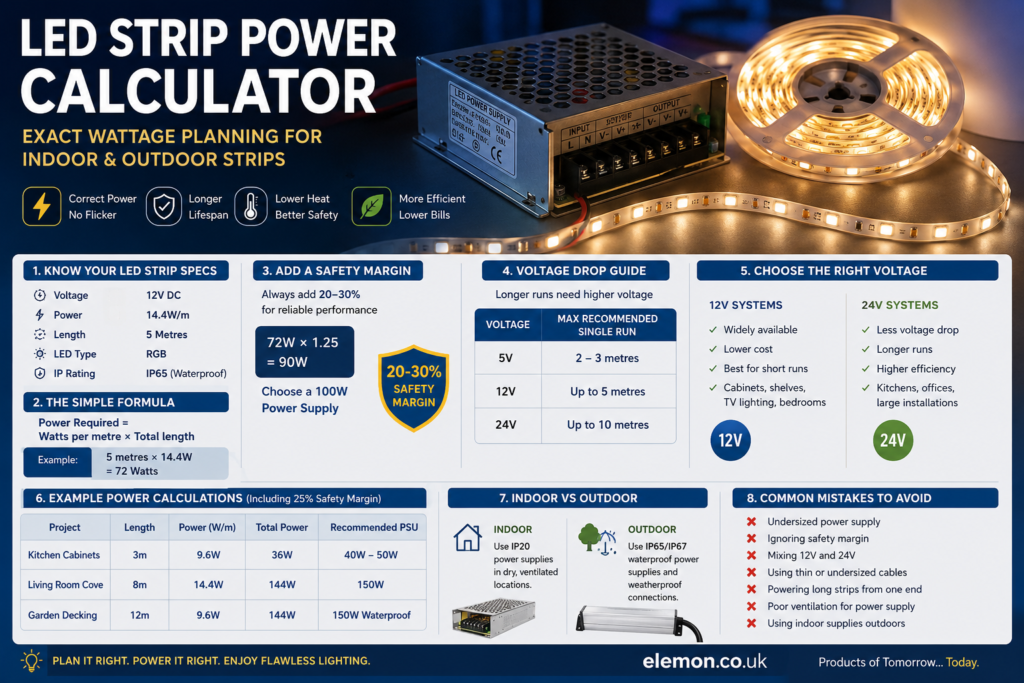
Power Required = Watts per metre × Total length
Example:
5 metres × 14.4W
= 72 Watts
However, never choose a power supply rated exactly 72W.
You should always add a safety margin.
The 20–30% Safety Rule
Professional installers never run a power supply at 100% capacity.
Instead:
Required Power × 1.25
Example:
72W
× 1.25
= 90W
A 100W power supply would be the correct choice.
Benefits include:
- Lower operating temperatures
- Longer lifespan
- Better reliability
- Capacity for small future additions
Example Calculations
Example 1
Kitchen under-cabinet lighting
Length:
3 metres
Power:
9.6W/m
Calculation:
3 × 9.6
= 28.8W
With safety margin:
36W
Recommended PSU:
40W or 50W
Example 2
Living room ceiling cove
Length:
8 metres
Power:
14.4W/m
Calculation:
8 × 14.4
= 115.2W
Safety margin:
144W
Recommended PSU:
150W
Example 3
Garden decking
Length:
12 metres
Power:
9.6W/m
Calculation:
12 × 9.6
= 115.2W
Safety margin:
144W
Recommended PSU:
150W waterproof supply
Indoor vs Outdoor Installations
Indoor power supplies typically use IP20-rated housings and should be installed in dry, ventilated locations.
Outdoor systems require waterproof (IP65/IP67) power supplies and weatherproof cable connections to protect against moisture and corrosion.
Always match the power supply’s protection rating to the environment.
Understanding Voltage Drop
Voltage drop becomes noticeable on long LED strip runs.
Common symptoms include:
- Dimmer far end
- Yellowing white LEDs
- Incorrect RGB colours
- Uneven brightness
General guidance:
| Voltage | Maximum Recommended Single Run |
|---|---|
| 5V | 2–3 m |
| 12V | 5 m |
| 24V | 10 m |
For longer installations, inject power at multiple points or use separate power feeds.
Choosing Between 12V and 24V
12V Systems
Advantages:
- Widely available
- Lower initial cost
- Ideal for smaller projects
Best for:
- Shelving
- Cabinets
- TV lighting
- Bedrooms
24V Systems
Advantages:
- Reduced voltage drop
- Longer cable runs
- Higher efficiency
- Better for large installations
Best for:
- Kitchens
- Offices
- Staircases
- Commercial spaces
- Large homes
Smart LED Strip Considerations
Smart controllers also consume power, although usually only a few watts.
If your installation includes:
- Wi-Fi controllers
- Zigbee hubs
- Bluetooth modules
- RGBW controllers
- Music synchronisation
allow a small additional power reserve beyond the LED strip calculation.
Common DIY Mistakes
Avoid these frequent errors:
- Buying the cheapest power supply
- Ignoring the safety margin
- Mixing 12V and 24V components
- Using undersized cables
- Powering long strips from one end only
- Installing power supplies without ventilation
- Placing indoor power supplies outdoors
Careful planning prevents expensive replacements later.
Example Power Requirement Table
| Strip Length | 4.8W/m | 9.6W/m | 14.4W/m |
|---|---|---|---|
| 2m | 10W | 20W | 30W |
| 5m | 30W | 60W | 90W |
| 10m | 60W | 120W | 180W |
| 15m | 90W | 180W | 270W |
| 20m | 120W | 240W | 360W |
These figures already include a recommended safety margin.
Indoor Project Ideas
Properly calculated LED strips work exceptionally well for:
- Kitchen cabinets
- Floating shelves
- TV backlighting
- Home cinema rooms
- Gaming desks
- Stair lighting
- Wardrobes
- Ceiling coves
- Hallways
- Bathrooms (with suitable IP ratings)
Outdoor Project Ideas
Outdoor LED strips can enhance:
- Decking
- Garden paths
- Pergolas
- Fencing
- Outdoor kitchens
- Patio seating
- Gazebos
- Driveways
- Steps
- Hot tub surrounds
Always use outdoor-rated strips, connectors, and power supplies.
Energy Efficiency
LED strips are among the most energy-efficient lighting solutions available.
Compared with traditional lighting, they typically:
- Use up to 80% less electricity
- Generate less heat
- Last 30,000–50,000 hours or more
- Require minimal maintenance
- Pair well with smart controls and timers to reduce energy use further
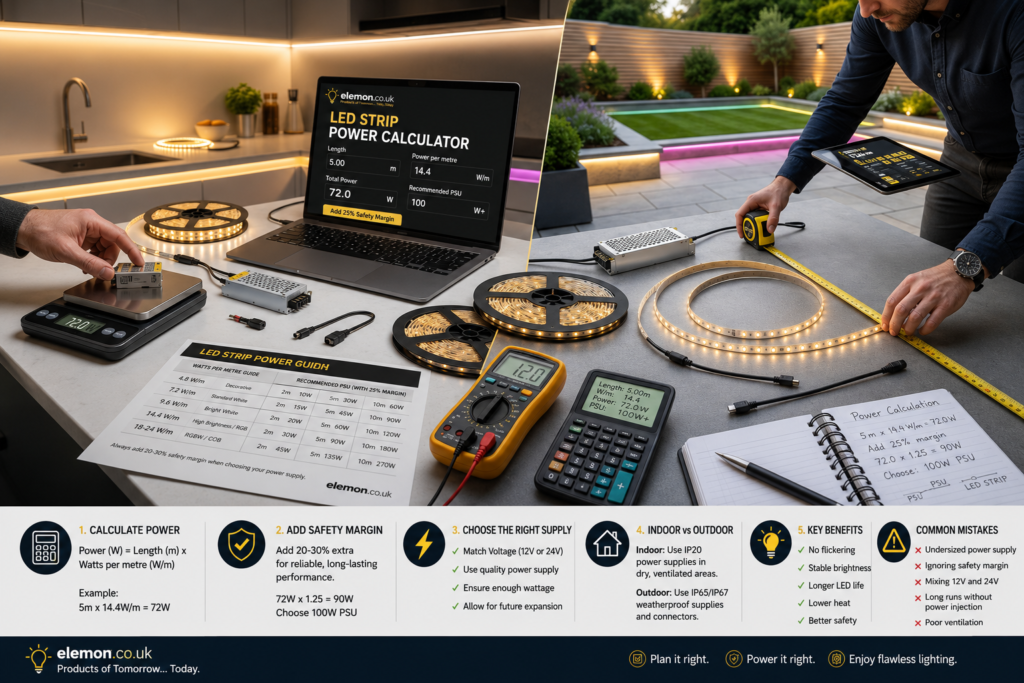
My Experience: Over the years, we’ve found that most LED strip issues are not caused by the strips themselves but by incorrect power planning. Choosing a quality power supply with around 25% spare capacity, using the correct voltage, and accounting for longer cable runs can make the difference between a professional-looking installation and one plagued by flickering or uneven brightness. Spending a little extra time on calculations before buying components usually saves both money and troubleshooting later.
Frequently Asked Questions
Can I use a larger power supply than I need?
Yes. A larger-rated power supply is generally fine, provided the voltage matches your LED strip (for example, a 12V strip must use a 12V power supply).
What happens if the power supply is too small?
The LEDs may flicker, dim, change colour, overheat the power supply, or cause it to shut down.
Should I choose 12V or 24V?
For short decorative runs, 12V is often sufficient. For longer installations, 24V usually offers better performance due to reduced voltage drop.
Do outdoor LED strips require special power supplies?
Yes. Outdoor installations should use appropriately weather-resistant power supplies and waterproof connectors suitable for the installation environment.
Key Takeaways
- Calculate total wattage using Watts per metre × Length.
- Add a 20–30% safety margin when selecting a power supply.
- Match the voltage of the power supply to the LED strip exactly.
- Use 24V systems for longer runs where practical.
- Plan for voltage drop on extended installations.
- Use suitable IP-rated components for outdoor projects.
- Good power planning improves reliability, efficiency, and the lifespan of your lighting system.
Related Articles on Elemon.co.uk
- DIY Smart Security Setup — Cameras, Sensors & Automation Workflows
- Smart Thermostat Calibration Guide
- Best Smart Home Starter Kits for UK Homes
- Outdoor Solar Lighting Installation Guide
- Best Smart Lighting Systems for Modern Homes
- Home Automation Ideas for Beginners
UK Safety Guidance
When working with electrical equipment, always isolate the mains supply before making connections. Use power supplies certified for the UK market and ensure they are installed in accordance with the manufacturer’s instructions. If your project involves new mains wiring, alterations to fixed electrical circuits, or work in locations with increased electrical risk, consult a qualified electrician and ensure compliance with current UK electrical regulations.
Affiliate Disclaimer: Some articles on Elemon.co.uk may contain affiliate links “Amazon Associate“. If you purchase a product through these links, we may earn a small commission at no additional cost to you. This helps support our independent reviews and allows us to continue creating free DIY and smart home content.