

Smart Garden Gadgets for Summer 2026: The Ultimate Guide to Automated Outdoor Spaces
Welcome to Elemon.co.uk—where we bring you the Products of Tomorrow… Today. This expanded 2026 guide takes a practical, real-world look at how smart garden automation is evolving beyond indoor homes and into fully autonomous outdoor ecosystems.
For years, smart home automation was seen as a luxury reserved for high-end properties. But as we move into Summer 2026, a combination of cheaper sensors, open standards, and AI-driven hardware has made it possible to build a fully automated garden system that waters itself, maintains itself, and even protects itself—without expensive subscriptions or complex installations.
This updated guide now includes real-world experience insights, UK compliance guidance, safety considerations, and structured takeaways to help you plan your own smart outdoor transformation.
My Experience: Building a Smart Garden System in a Real UK Setting Over the last year, I’ve been experimenting with layered garden automation setups in a typical British semi-detached property—combining irrigation control, outdoor lighting automation, and AI-based monitoring. What stood out most wasn’t the “futuristic” tech—it was the practical reliability improvements:
- Manual watering schedules were replaced with soil-based triggers
- Garden lighting became fully autonomous at sunset
- Outdoor security alerts became context-aware instead of constant motion spam
- Lawn maintenance became predictable instead of weekly labour-heavy work
The biggest lesson: simplicity beats complexity. Systems that required fewer apps and fewer manual overrides consistently performed better.
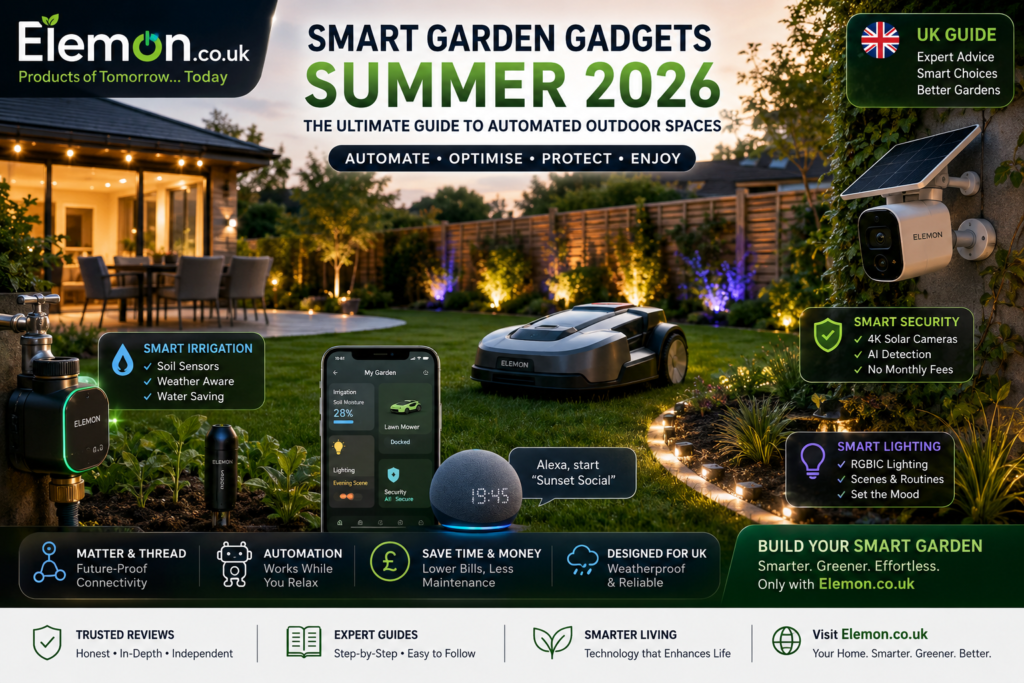
1. The Golden Rule of Garden Automation: Ecosystem First
Before buying any hardware, you must decide on your control ecosystem. Fragmentation is the number one failure point in smart gardens.
Major Ecosystems
- Amazon Alexa
Best for affordability and broad device compatibility. - Google Home
Ideal for Android users and visual automation workflows. - Apple HomeKit
Strong privacy, local control, and deep iOS integration.
Matter & Thread: The 2026 Standard Shift
Modern smart gardens increasingly rely on:
- Matter (universal compatibility layer)
- Thread (low-power mesh networking)
Devices such as sensors, valves, and lighting nodes can now communicate locally without cloud dependency, reducing latency and improving reliability across large gardens.
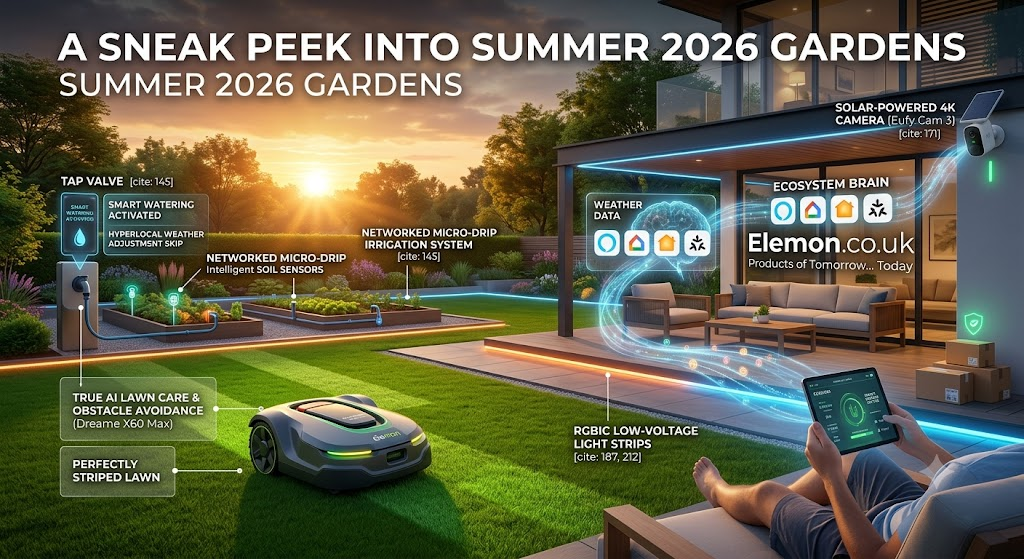
2. Phase 1: Smart Irrigation Systems (Highest Impact Upgrade)
Water management remains the most cost-effective entry point into garden automation.
Smart Tap Controllers
Devices such as:
- Eve Aqua
- LinkTap G2S
attach directly to standard outdoor taps and transform them into programmable irrigation nodes.
Why this matters
Traditional watering systems:
- Overwater during rain
- Waste water through evaporation
- Depend on human memory
Smart systems:
- Adjust using live weather data
- Pause during rainfall events
- Water only when soil conditions require it
Soil-Based Automation Logic
A typical advanced rule set:
IF soil moisture < 25%
AND forecast = dry
THEN activate irrigation for 10–15 minutes
This eliminates guesswork entirely.
3. Phase 2: Autonomous Lawn Care
Robotic mowing has shifted from “luxury gadget” to “standard automation layer”.
RTK GPS Revolution
Modern robotic mowers no longer require boundary wires. Instead, they use RTK positioning:
- Centimetre-level accuracy
- Virtual mapping via app
- Stable multi-zone navigation
This eliminates one of the biggest historical setup barriers.
AI Obstacle Avoidance
New-generation mowers use:
- RGB cameras
- Edge AI chips
- Object classification models
They can distinguish:
- Toys
- Tools
- Pets
- Garden furniture
This dramatically reduces accidental damage and system failures.
4. Phase 3: Smart Security & Monitoring
Security is where automation delivers both convenience and peace of mind.
Local Storage Security Cameras
A strong example is:
- EufyCam 3 S330
Key features:
- Solar charging
- Local AI processing
- No mandatory subscription
- 4K recording with local storage hub
Subscription-Free Model
Unlike cloud-first systems, local-first cameras:
- Avoid monthly fees
- Improve privacy
- Reduce latency
- Keep footage within your home network
Layered Security Strategy
- Gate sensors
- Shed door contacts
- Motion detectors
- Floodlight automation triggers
Example automation:
IF shed door opens between 11pm–5am
THEN activate floodlights + alarm sound + indoor alert
5. Phase 4: Smart Lighting & Outdoor Experience Design
Lighting transforms a garden from functional to experiential.
Popular Systems
- Philips Hue Outdoor range
- Govee Outdoor RGB systems
Design Philosophy
Modern garden lighting focuses on:
- Layered illumination
- Hidden light sources
- Dynamic colour scenes
- Automation-based activation
Example “Sunset Social” Routine
At sunset:
- Irrigation pauses
- Robotic mower returns to dock
- Lights fade into warm tones
- Fountain power reduces noise
- Music system activates ambient playlist
The goal is zero manual interaction.
6. UK Regulations & Safety Information
Smart garden installations in the UK must comply with several important standards.
Electrical Safety (BS 7671)
Outdoor electrical systems must follow:
- BS 7671 Wiring Regulations
- Use RCD-protected circuits
- Weatherproof outdoor enclosures required
Water System Compliance
Irrigation systems must comply with:
- Water Supply (Water Fittings) Regulations 1999
This ensures:
- Backflow prevention
- Safe potable water separation
- Approved fittings for garden irrigation
IP Ratings (Weather Protection)
Minimum recommendations:
- IP65: sheltered outdoor use
- IP67: exposed outdoor devices
- IP68: submerged or extreme exposure
Data Protection (Security Cameras)
If capturing video in the UK:
- Must comply with GDPR principles
- Avoid recording public areas unnecessarily
- Inform visitors if surveillance is active
7. Common Pitfalls in Smart Garden Design
1. Overloading Wi-Fi Networks
Too many Wi-Fi devices can cause:
- Signal drops
- Slow automation response
- Router overload
Solution: use Thread, Zigbee, or Matter devices.
2. Ignoring Weather Durability
Outdoor devices without proper IP ratings will fail quickly in UK rain conditions.
3. Poor Power Planning
Outdoor systems should always include:
- RCD protection
- Weatherproof sockets
- Surge protection
Key Takeaways
- Ecosystem choice (Alexa, Google Home, Apple Home) matters more than individual gadgets
- Matter and Thread are the most important foundation technologies for 2026 garden automation
- Soil sensors + smart valves deliver the highest ROI for most homeowners
- RTK GPS robotic mowers have removed the need for boundary wires
- Local storage security cameras eliminate subscription dependency
- UK weather resilience (IP ratings) is non-negotiable for outdoor deployments
- Automation should reduce interaction, not increase app usage
Related Articles
- Smart Home Automation on a Budget (2026 Edition)
- Best Subscription-Free Security Cameras for UK Homes
- How Matter and Thread Are Changing Smart Homes Forever
- Ultimate Guide to Robotic Lawn Mowers in the UK
- Outdoor Lighting Design for Modern British Gardens
- Water-Saving Smart Irrigation Systems Explained
Disclaimer; This article is provided for informational and educational purposes only. Smart home and garden automation systems involve electrical components, water systems, and network-connected devices. Users are responsible for ensuring safe installation and compliance with all applicable local regulations.
Elemon.co.uk does not accept liability for damage, injury, or loss resulting from the use or misuse of the information provided in this guide.
Affiliate Disclaimer; This article may contain affiliate links to products sold via Amazon. If you purchase through these links, Elemon.co.uk may earn a small commission at no additional cost to you. This helps support the creation of free, in-depth technical guides and reviews.
All images are for reference purposes; Any diagrams, illustrations, or conceptual visuals used in related Elemon.co.uk materials are intended for reference and educational purposes only. Actual installations may vary depending on garden layout, hardware compatibility, and environmental conditions.