
How to Automate Your Home on a Budget in 2026
Published by Elemon.co.uk – Products of Tomorrow… Today
Affiliate Disclaimer; As an Amazon Associate, Elemon.co.uk may earn from qualifying purchases. This comes at no extra cost to you and helps support our independent reviews, guides, and technology content.
How to Automate Your Home on a Budget : The Complete UK Smart Home Guide
Smart homes were once associated with luxury properties, celebrity mansions, and expensive custom installations. Just a decade ago, creating an automated home often required specialist electricians, proprietary hardware, and thousands of pounds of investment.
Today, the situation is dramatically different.
Affordable smart devices, open standards such as Matter, powerful voice assistants, and DIY-friendly technology have transformed home automation into something accessible to almost everyone. Whether you live in a flat, terraced house, semi-detached property, or a larger family home, you can build a practical and reliable smart home without spending a fortune.
At Elemon.co.uk, we believe technology should make life easier, safer, and more efficient. This guide explains exactly how to automate your home on a budget while avoiding common mistakes that cost homeowners money.
Why Home Automation Makes Sense
Many people assume smart homes are simply about convenience.
While voice-controlled lights and automated coffee makers are certainly useful, the real value comes from:
- Lower energy bills
- Improved security
- Greater comfort
- Better accessibility
- Reduced energy waste
- Increased property appeal
- Remote monitoring capabilities
With UK energy costs remaining a significant concern for households, automation can actively help reduce consumption and improve efficiency.
The key is choosing the right devices and deploying them strategically.
Start With a Plan Before Buying Anything
One of the biggest mistakes new smart home users make is purchasing random gadgets because they appear inexpensive.
A £10 smart plug here and a £15 bulb there may seem like bargains, but if they all require different apps and don’t communicate with one another, your smart home quickly becomes frustrating.
Before purchasing anything, decide which ecosystem will serve as the central brain of your home.
Choosing Your Smart Home Ecosystem
Amazon Alexa
Amazon Alexa remains one of the most budget-friendly smart home platforms available.
Benefits include:
- Excellent compatibility
- Huge range of affordable devices
- Easy automation routines
- Strong voice control
- Wide UK availability
Budget-conscious homeowners often find Alexa provides the best value.
Google Home
Google Home excels in natural voice recognition and integrates perfectly with Android devices.
Advantages include:
- Excellent AI-powered commands
- Seamless Google ecosystem integration
- Simple automation setup
- Strong location-based automations
Apple Home
Apple’s Home platform offers outstanding privacy and security.
Benefits include:
- Secure local processing
- Clean user experience
- Strong iPhone integration
- Matter support
While some HomeKit-certified products remain slightly more expensive, Matter compatibility is helping reduce costs significantly.
Understanding Matter and Why It Matters
Matter is the future of smart homes.
Instead of relying on brand-specific systems, Matter allows devices from different manufacturers to work together.
Benefits include:
- Faster setup
- Better reliability
- Local communication
- Reduced dependency on cloud services
- Greater device choice
Whenever possible, choose Matter-compatible products.
Doing so helps future-proof your smart home and prevents expensive compatibility issues later.
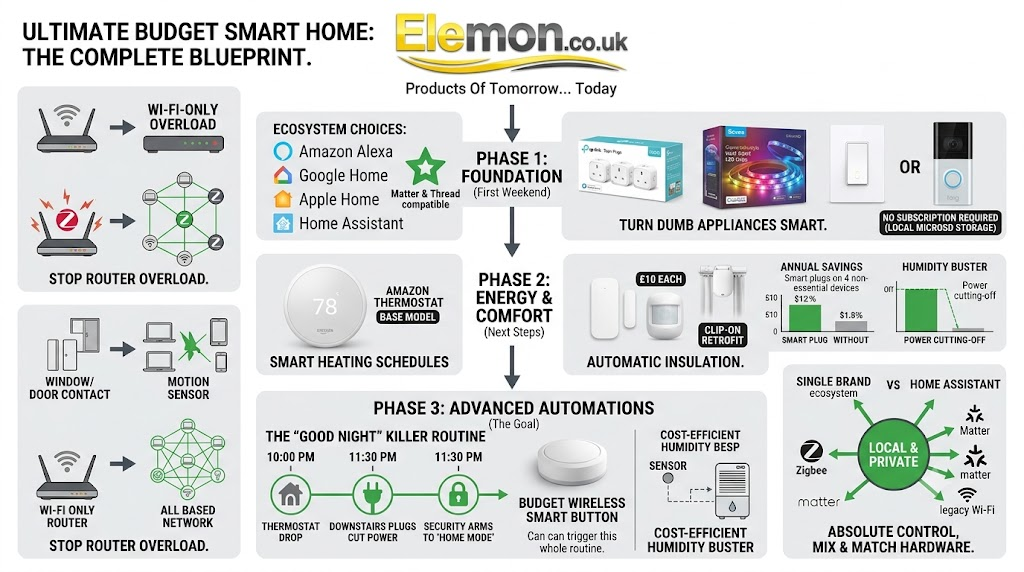
Phase One: Smart Home Essentials Under £50
Smart Plugs
If there is one device every beginner should buy, it is a smart plug.
A smart plug instantly converts ordinary appliances into smart devices.
Examples include:
- Lamps
- Coffee machines
- Fans
- Heaters
- Air purifiers
- Dehumidifiers
Functions include:
- Scheduled operation
- Voice control
- Remote access
- Energy monitoring
Rather than replacing functioning appliances, simply automate what you already own.
This approach saves hundreds of pounds.
Smart Lighting
Lighting is often the first smart home upgrade people notice.
Fortunately, it doesn’t have to be expensive.
Budget-friendly options include:
- Smart bulbs
- LED light strips
- Smart switches
- Smart dimmers
For the best value, focus on areas where lighting creates the greatest impact:
- Living rooms
- Bedrooms
- Home offices
- Kitchen workspaces
Automated lighting schedules can also improve security by making your property appear occupied when you’re away.
Motion Sensors
Motion sensors are inexpensive but powerful.
Possible automations include:
- Hallway lights activating automatically
- Bathroom lights switching on at night
- Security notifications
- Energy-saving controls
A simple sensor can dramatically improve convenience throughout the home.
Phase Two: Reducing Energy Costs
With energy prices remaining a major concern in the UK, this is where automation starts generating genuine financial returns.
Smart Thermostats
Heating accounts for a substantial portion of household energy usage.
Smart thermostats help by:
- Learning routines
- Optimising heating schedules
- Preventing wasted heating
- Supporting remote control
Even entry-level models can generate meaningful savings over time.
Popular budget-friendly choices include:
- Hive Mini
- Google Nest Thermostat
- Tado Smart Thermostat
Geofencing Technology
Geofencing uses your smartphone location to trigger automations.
Examples include:
When leaving home:
- Heating turns down
- Lights switch off
- Security system arms
When returning:
- Heating activates
- Selected lights turn on
- Smart locks prepare for entry
This prevents unnecessary energy consumption.
Automated Curtains and Blinds
Windows are responsible for significant heat gain and heat loss.
Affordable curtain robots can:
- Close curtains at sunset
- Open blinds at sunrise
- Block excessive summer heat
- Improve winter insulation
Rather than replacing existing blinds, retrofit solutions deliver similar benefits at a fraction of the cost.
Phase Three: Budget Smart Security
Home security is one of the most valuable uses of automation technology.
Fortunately, modern systems no longer require costly monitoring contracts.
Video Doorbells
Video doorbells provide:
- Motion alerts
- Visitor notifications
- Package monitoring
- Two-way communication
Look for systems supporting:
- Local storage
- MicroSD recording
- No mandatory subscriptions
Avoid paying monthly fees whenever possible.
Smart Cameras
Budget security cameras now offer:
- 2K resolution
- Night vision
- AI motion detection
- Local recording
Position cameras carefully to monitor:
- Front doors
- Driveways
- Rear entrances
- Garden access points
Contact Sensors
These inexpensive sensors monitor:
- Doors
- Windows
- Gates
- Cabinets
When opened, they can:
- Send phone alerts
- Trigger alarms
- Activate lighting
- Record camera footage
For complete property coverage, contact sensors often provide better value than additional cameras.
Smart Home Automations That Actually Save Time
The best automations operate quietly in the background.
Good Morning Routine
Trigger: 7:00 AM
Actions:
- Bedroom lights gradually brighten
- Kitchen lights activate
- Coffee machine powers on
- News briefing starts
Your home prepares for the day automatically.
Away Mode
Trigger: Everyone leaves home
Actions:
- Lights switch off
- Heating reduces
- Cameras activate
- Security system arms
This is one of the easiest ways to reduce energy waste.
Good Night Routine
Trigger: Bedtime
Actions:
- Lights turn off
- Doors lock
- Cameras activate
- Thermostat adjusts
- Smart plugs disable standby devices
This automation combines convenience, security, and efficiency.
Moisture and Mould Prevention
Damp and mould problems can be expensive to fix.
Smart sensors provide an affordable solution.
A typical setup involves:
- Humidity sensor
- Smart plug
- Dehumidifier
When humidity exceeds 65%:
- Dehumidifier activates
When humidity drops below 45%:
- Device switches off
This ensures energy is only used when necessary.
Smart Home Automation for Renters
Many people assume smart homes are only suitable for homeowners.
In reality, renters can automate extensively without modifying the property.
Excellent renter-friendly options include:
- Smart plugs
- Smart bulbs
- Portable sensors
- Smart speakers
- Curtain robots
- Battery-powered cameras
Most installations can be removed when moving house.
Building a Smart Home Gradually
One of the most effective budget strategies is phased deployment.
Month 1:
- Smart speaker
- Smart plugs
Month 2:
- Smart lighting
Month 3:
- Motion sensors
Month 4:
- Security devices
Month 5:
- Smart thermostat
Month 6:
- Advanced automations
This spreads costs while allowing you to learn as you go.
Advanced Budget Automation With Home Assistant
Eventually many enthusiasts discover Home Assistant.
Home Assistant is a free open-source smart home platform that runs locally.
Benefits include:
Brand Independence
Mix devices from different manufacturers freely.
Local Processing
Automations continue operating even if internet access fails.
Enhanced Privacy
Data remains inside your home.
Unlimited Automation Potential
Virtually any logic or condition can be created.
For serious DIY users, Home Assistant offers incredible value.
Common Smart Home Mistakes to Avoid
Buying Too Many Wi-Fi Devices
Cheap routers can struggle with dozens of connected devices.
Consider:
- Matter
- Zigbee
- Thread
These protocols reduce Wi-Fi congestion.
Ignoring Security
Always:
- Use strong passwords
- Enable two-factor authentication
- Update firmware regularly
Security should never be overlooked.
Chasing Cheap Unknown Brands
Ultra-cheap devices often disappear when manufacturers stop supporting them.
Choose reputable brands with proven ecosystems.
Over-Automating
Not every appliance needs automation.
Focus on:
- High-use devices
- Energy savings
- Security
- Convenience
Avoid creating unnecessary complexity.
Future Smart Home Trends
Looking ahead, several technologies are becoming increasingly affordable:
- AI-powered home management
- Energy-aware automation
- Solar integration
- Smart EV charging
- Predictive maintenance systems
- Enhanced occupancy detection
Many of these features are already appearing in budget-friendly products.
The smart home revolution is only beginning.
My Experience
Over the past few years, I’ve experimented with numerous budget smart home devices ranging from simple smart plugs to complete Home Assistant setups.
The biggest lesson learned is that expensive hardware does not automatically create a better smart home.
In many cases, a £10 smart plug connected to a carefully designed automation routine provides more value than a £300 premium gadget.
I have found that the most useful automations are usually the simplest:
- Lights switching off automatically
- Heating adjusting when nobody is home
- Security alerts for doors and windows
- Humidity-controlled ventilation
By focusing on practical everyday problems rather than flashy features, homeowners can create genuinely useful smart homes while spending surprisingly little money.
Key Takeaways
✓ Choose your ecosystem before buying devices.
✓ Prioritise Matter-compatible products.
✓ Start with smart plugs and lighting.
✓ Use automation to reduce energy consumption.
✓ Consider local-storage security systems to avoid subscriptions.
✓ Add sensors for greater automation flexibility.
✓ Deploy devices gradually to spread costs.
✓ Explore Home Assistant for advanced control.
✓ Avoid unreliable no-name smart home brands.
✓ Focus on solving real problems rather than adding unnecessary complexity.
UK Regulations & Safety Information
When installing smart home equipment in the United Kingdom:
- Follow all applicable electrical safety regulations.
- Do not attempt mains wiring modifications unless suitably qualified.
- Ensure smart plugs and switches carry appropriate UK safety certifications.
- Use products compliant with UKCA requirements where applicable.
- Follow manufacturer installation instructions carefully.
- Smart locks should not compromise emergency exit routes.
- Battery-powered devices should be checked regularly.
- Security cameras must comply with UK privacy laws and data protection requirements.
- If cameras record public areas, additional legal obligations may apply.
For complex electrical installations, consult a qualified electrician.
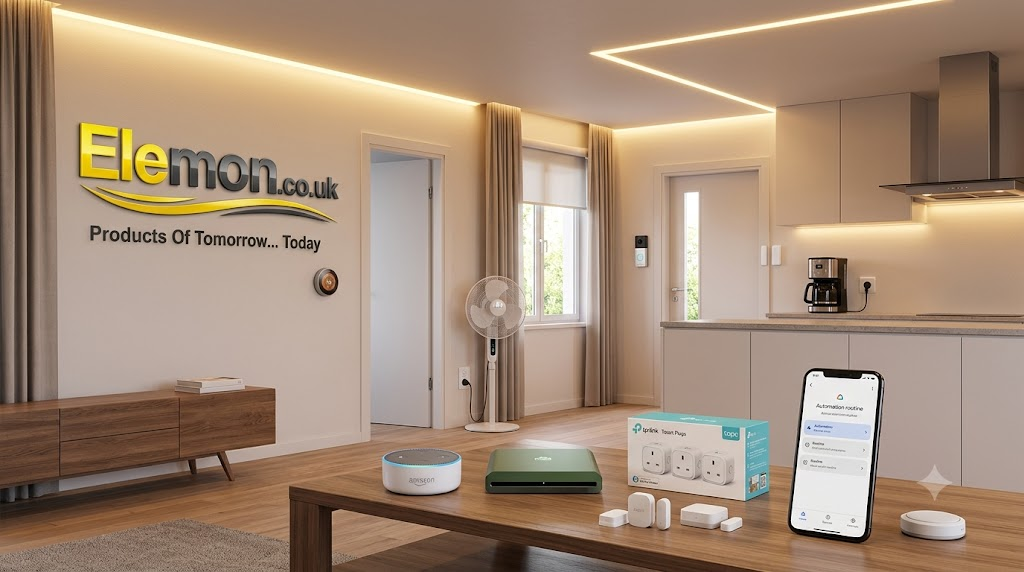
Related Articles on Elemon.co.uk
- Best Smart Lighting Systems for 2026
- Top 10 Smart Gadgets That Actually Save Money
- Best Smart Security Cameras for UK Homes
- Home Assistant Beginner’s Guide
- Matter vs Zigbee vs Thread: Which Smart Home Standard Wins?
Final Thoughts
Creating a smart home no longer requires a luxury budget. Thanks to affordable devices, open standards like Matter, and powerful automation platforms, virtually any UK household can enjoy the benefits of home automation.
The smartest approach is not spending more money—it is spending wisely. Begin with simple, high-impact upgrades such as smart plugs, lighting, and sensors. Build your ecosystem gradually, automate real-world tasks, and focus on improving comfort, security, and efficiency.
By following the strategies outlined in this guide, you can transform your property into a connected, intelligent home while keeping costs firmly under control.
For more smart home guides, emerging technology reviews, and practical DIY tech advice, visit Elemon.co.uk — Products of Tomorrow… Today.
Disclaimer
This article is intended for informational and educational purposes only.
Technology specifications, pricing, compatibility, and availability may change over time. Readers should conduct their own research before purchasing products or undertaking electrical work.
Elemon.co.uk accepts no responsibility for damages, losses, or injuries resulting from the use of information contained within this guide.
Professional advice should be sought where appropriate.
Image Disclaimer
All images used in this article are for reference purposes only. Actual products, installations, colours, features, and specifications may vary depending on manufacturer updates and regional availability.