
The Future of Smart Homes in 2026 and Beyond
“Products of Tomorrow… Today.”
For years, the idea of a smart home sounded like something reserved for luxury properties or science fiction films. Today, however, intelligent technology has become far more accessible, allowing homeowners across the UK to automate everyday tasks, improve security, reduce energy bills, and enjoy greater comfort without major renovations.
At Elemon.co.uk, we’ve watched the smart home industry evolve from simple Wi-Fi light bulbs into sophisticated ecosystems capable of learning routines, managing energy consumption, and protecting homes around the clock. What once required expensive specialist installers can now often be achieved through carefully selected DIY products that work together seamlessly.
The next stage of this evolution is even more exciting.
Rather than simply responding to commands, tomorrow’s smart homes will predict your needs, optimise energy use automatically, and make thousands of tiny decisions every day to improve your quality of life.
Whether you’re planning your first smart home upgrade or looking to future-proof your property, understanding where technology is heading will help you invest in products that remain useful for years to come.
Why Smart Homes Are Changing Faster Than Ever
Several major innovations are accelerating the smart home revolution.
Artificial intelligence has become significantly more capable while also becoming affordable enough to run on local devices rather than relying entirely on cloud services. At the same time, new universal communication standards are finally allowing products from different manufacturers to work together more reliably.
Meanwhile, rising electricity costs continue encouraging homeowners to monitor energy consumption more closely than ever before.
These developments are creating homes that don’t simply react—they actively assist.
Instead of pressing buttons, opening apps, or remembering complicated routines, homeowners increasingly expect technology to work quietly in the background.
The Biggest Shift: From Smart Devices to Intelligent Homes
One of the biggest misconceptions about smart homes is believing that buying dozens of connected gadgets automatically creates an intelligent property.
It doesn’t.
A truly modern smart home isn’t defined by how many connected devices you own.
It’s defined by how well those devices work together.
Instead of isolated products, future homes operate as a single coordinated system where lighting, heating, security, entertainment, appliances, and energy management continuously communicate with each other.
Rather than saying:
“Turn on the hallway light.”
Your home might instead understand:
- You usually arrive home around 6:15 pm.
- It’s raining outside.
- The sunset has already passed.
- Your family is still out.
- Your hallway is currently dark.
Without any manual interaction, it can automatically:
- Unlock the door securely
- Switch on pathway lighting
- Adjust heating
- Start calming background music
- Warm the living room
- Activate kitchen lighting
- Disable the security alarm
All before you’ve even taken your coat off.
That’s the difference between connected gadgets and intelligent automation.
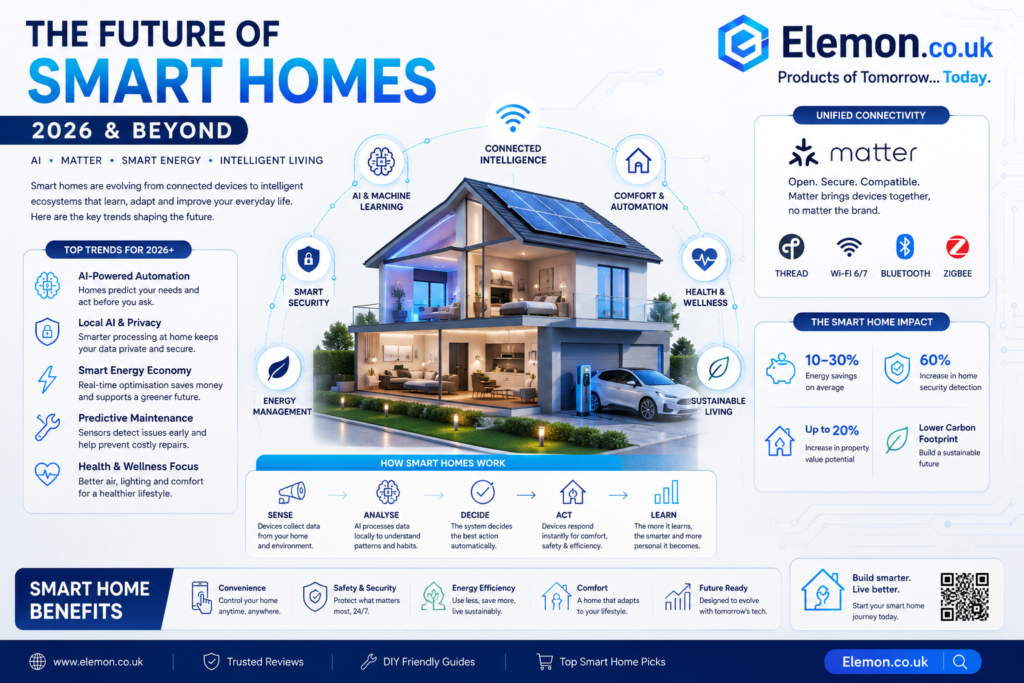
Trend 1 – Artificial Intelligence That Learns Your Lifestyle
Artificial Intelligence (AI) is becoming the brain of the modern smart home.
Early automation relied on fixed routines:
- Lights at 7 pm
- Heating at 6 am
- Coffee machine at 7:30 am
While useful, these schedules quickly became frustrating whenever life changed.
Today’s AI systems continuously learn from your behaviour.
They can recognise:
- Daily routines
- Preferred room temperatures
- Lighting preferences
- Entertainment habits
- Sleep schedules
- Seasonal changes
- Weekend patterns
Instead of following rigid schedules, AI continuously adjusts based on real-life behaviour.
For example:
If you normally leave for work at 8:00 am but begin working from home more frequently, your heating schedule gradually adapts without requiring manual programming.
Similarly, lighting scenes can evolve depending on the season, weather, or how much natural daylight enters your home.
The more consistently you use your devices, the more accurately the system predicts your preferences.
AI Is Becoming More Personal
Future AI won’t simply understand households.
It will increasingly understand individual people.
Different family members may automatically receive:
- Personal lighting preferences
- Favourite room temperatures
- Music playlists
- Television profiles
- Home office settings
- Bedtime routines
Imagine walking into your office and your preferred lighting, desk fan, monitor, and background music all activating automatically without touching a single switch.
This level of personalisation is becoming increasingly achievable thanks to improved local processing and smarter occupancy detection.
Trend 2 – Local AI Will Replace Cloud Dependence
One of the most important developments happening today receives surprisingly little attention.
For many years, smart homes relied heavily on cloud servers.
When you asked a smart speaker to switch on a light, that request often travelled thousands of miles to a remote data centre before returning to your home.
While convenient, this approach introduced several disadvantages.
If your internet connection failed:
- Voice assistants stopped working.
- Automations failed.
- Cameras lost features.
- Smart locks sometimes became limited.
- Response times slowed dramatically.
The future is moving towards local-first intelligence.
Instead of depending on distant servers, modern smart home hubs increasingly process information directly inside your property.
This offers several major benefits.
Faster Performance
Because commands never leave your home network, devices respond almost instantly.
Lights switch on faster.
Sensors react more quickly.
Door locks feel more responsive.
Voice assistants answer with noticeably lower delay.
Improved Privacy
Many homeowners are becoming more conscious about digital privacy.
Local processing means:
- Camera footage stays inside your home.
- Voice commands remain private.
- Occupancy information isn’t constantly uploaded.
- Personal routines aren’t continuously analysed by external companies.
For households concerned about cybersecurity, this represents a significant improvement.
Better Reliability
Internet outages become far less disruptive.
Essential automations continue operating, including:
- Heating schedules
- Lighting scenes
- Security sensors
- Smart locks
- Motion detection
- Smoke alarms
- Energy monitoring
A genuinely smart home should continue functioning even when broadband doesn’t.
Trend 3 – Matter Is Finally Making Smart Homes Simpler
One of the biggest frustrations homeowners faced over the past decade was compatibility.
You’d buy one smart device only to discover it didn’t work with another.
Some products required their own apps.
Others needed expensive hubs.
Some simply refused to communicate.
Thankfully, that’s changing.
The arrival of Matter, supported by many of the world’s largest technology companies, is making interoperability far easier.
Rather than locking customers into one ecosystem, Matter allows compatible devices to communicate using shared standards.
For homeowners, this means greater flexibility when expanding a smart home over time.
Instead of replacing everything from one manufacturer, you’ll increasingly be able to choose the best product for each job.
For example:
| Traditional Smart Home | Modern Matter Ecosystem |
|---|---|
| Multiple apps | Unified control |
| Brand restrictions | Cross-brand compatibility |
| Complex setup | Faster installation |
| Limited automation | Greater flexibility |
| Frequent compatibility issues | Easier long-term upgrades |
This shift makes future upgrades considerably more affordable while reducing electronic waste.
Trend 4 – Homes That Know You’re There
Traditional motion sensors only detect movement.
Anyone sitting quietly reading a book has probably experienced lights suddenly switching off.
Modern homes are beginning to solve this problem using advanced presence sensing technologies.
Rather than simply detecting motion, these systems recognise occupancy itself.
They can determine:
- Someone is sitting still
- Someone has entered the room
- Room occupancy levels
- General movement patterns
This allows automations to become much more natural.
Examples include:
- Lights remaining on while watching television
- Heating adjusting according to occupied rooms
- Fans slowing when rooms become empty
- Music following occupants between spaces
- Security systems recognising normal household movement
Future presence detection will become even more accurate without relying heavily on cameras, helping maintain privacy while improving automation.
Looking Ahead
The smart home industry is entering one of its most exciting periods yet.
Artificial intelligence, local processing, universal connectivity standards, and intelligent occupancy detection are transforming homes from collections of connected gadgets into genuinely helpful living environments.
Trend 5 – Smart Energy Management Will Save More Than Just Electricity
With energy prices continuing to fluctuate across the UK, homeowners are paying closer attention to how—and when—they use electricity. Smart homes are evolving from simple automation systems into intelligent energy managers capable of reducing waste and lowering monthly bills without sacrificing comfort.
The next generation of smart homes doesn’t simply switch appliances on and off. Instead, it analyses your daily routines, electricity tariffs, renewable energy production, and weather forecasts to optimise energy usage automatically.
Imagine your home deciding to:
- Charge your electric vehicle overnight when electricity is cheapest.
- Run the washing machine during off-peak hours.
- Store excess solar energy in a home battery.
- Delay non-essential appliances until renewable energy production increases.
- Reduce heating in unoccupied rooms without affecting comfort.
These decisions happen in the background, helping homeowners reduce energy costs while supporting a more sustainable lifestyle.
Intelligent Appliance Scheduling
Many modern appliances are already becoming “energy aware.”
Future smart homes will automatically coordinate devices such as:
- Washing machines
- Dishwashers
- Tumble dryers
- Heat pumps
- Water heaters
- Electric vehicle chargers
Rather than running simultaneously, these appliances will communicate with one another to prevent unnecessary peaks in electricity demand.
This balanced approach not only saves money but can also extend the lifespan of electrical systems within the home.
Solar Integration Is Becoming Mainstream
Solar panels are no longer viewed solely as an environmental investment.
When combined with smart home technology, they become part of a complete energy ecosystem.
A modern system can intelligently decide whether to:
- Use solar electricity immediately.
- Charge a home battery.
- Export electricity back to the National Grid.
- Power high-energy appliances.
- Charge an electric vehicle.
Instead of homeowners constantly monitoring energy production, automation software makes these decisions continuously throughout the day.
Trend 6 – Predictive Maintenance Will Protect Your Home
One of the most exciting developments in smart home technology is predictive maintenance.
Instead of discovering problems after damage occurs, future homes will increasingly detect warning signs before they become expensive repairs.
Smart sensors can already monitor:
- Water leaks
- Humidity
- Temperature fluctuations
- Smoke
- Carbon monoxide
- Door and window activity
The next generation of systems adds intelligence by recognising patterns over time.
For example:
A tiny water leak beneath a sink may go unnoticed for weeks.
A smart leak sensor can identify unusual moisture levels immediately and notify the homeowner before mould develops or structural damage occurs.
Similarly, HVAC systems can monitor their own efficiency.
If airflow begins decreasing gradually, the system may recommend replacing a filter long before performance noticeably declines.
This proactive approach helps reduce maintenance costs while improving property longevity.
Structural Health Monitoring
Future smart homes may also monitor the condition of the building itself.
Emerging technologies can detect:
- Foundation movement
- Excessive vibration
- Pipe pressure changes
- Roof moisture
- Window seal failures
- Indoor air quality changes
Although currently more common in commercial buildings, these technologies are becoming increasingly affordable for residential properties.
Trend 7 – Smarter Home Security with Artificial Intelligence
Home security has progressed far beyond traditional burglar alarms.
Modern systems combine multiple technologies into a coordinated security network.
These include:
- Smart cameras
- Video doorbells
- Motion sensors
- Door sensors
- Window sensors
- Smart locks
- Floodlights
- Indoor sirens
Artificial intelligence makes these devices significantly more useful.
Instead of recording every movement, intelligent systems increasingly recognise the difference between:
- Family members
- Visitors
- Delivery drivers
- Pets
- Wildlife
- Vehicles
- Suspicious behaviour
This dramatically reduces false alerts.
Smarter Notifications
Nobody wants dozens of unnecessary phone notifications every day.
Future systems prioritise meaningful events.
Rather than saying:
Motion detected.
They may instead notify:
“Parcel delivered at the front door.”
or
“Unknown person remained near the side entrance for five minutes.”
This level of contextual awareness allows homeowners to respond appropriately without constantly checking camera feeds.
Smarter Access Control
Physical keys continue disappearing from modern homes.
Instead, homeowners increasingly use:
- Smartphones
- Smart watches
- Temporary digital keys
- NFC credentials
- Biometric verification
Future access systems may even recognise approaching family members automatically and unlock doors without requiring any interaction.
Temporary access can also be granted securely for:
- Cleaners
- Gardeners
- Dog walkers
- Holiday guests
- Tradespeople
Permissions can automatically expire after a chosen time period, improving convenience without compromising security.
Trend 8 – Health and Wellness Will Become Part of Every Smart Home
Technology isn’t only making homes smarter—it is making them healthier.
Many future smart homes will quietly monitor environmental conditions that influence physical wellbeing.
These include:
- Temperature
- Humidity
- Air quality
- Carbon dioxide levels
- Fine dust particles
- Noise levels
- Lighting quality
Rather than simply displaying numbers, automation systems can respond automatically.
Examples include:
- Opening smart windows when air quality declines.
- Activating air purifiers.
- Adjusting ventilation.
- Controlling humidity.
- Changing lighting to support healthier sleep.
Circadian Lighting
Lighting has a surprisingly significant effect on sleep and productivity.
Modern smart lighting increasingly adjusts throughout the day.
Morning lighting may:
- Be brighter
- Use cooler white tones
- Encourage alertness
Evening lighting gradually shifts towards:
- Warmer colours
- Lower brightness
- Reduced blue light
This helps support the body’s natural circadian rhythm while creating a more relaxing evening environment.
Smart Sleep Environments
Future bedrooms may automatically optimise themselves before bedtime.
Systems could:
- Lower room temperature.
- Dim lighting gradually.
- Close blinds.
- Reduce notifications.
- Activate white noise.
- Adjust mattress settings.
- Switch devices into silent mode.
Rather than manually preparing the room each evening, automation quietly creates an ideal sleeping environment.
Trend 9 – Voice Assistants Are Becoming More Natural
Voice control remains one of the most recognisable smart home features, but it is changing rapidly.
Early assistants relied on precise commands.
Today’s AI models understand natural conversation much more effectively.
Instead of saying:
“Turn kitchen lights on.”
You may simply say:
“It’s getting a bit dark in here.”
Your home understands the intention rather than requiring a memorised command.
Future assistants will also remember conversational context.
For example:
“Turn on the living room lights.”
Followed by:
“Dim them to fifty percent.”
No additional explanation is required.
This more natural interaction makes technology feel less like software and more like a helpful assistant.
Trend 10 – Sustainability Will Be Built Into Every Smart Home
Environmental responsibility is becoming an increasingly important consideration for homeowners.
Fortunately, many smart technologies naturally support more sustainable living.
Automation can help reduce:
- Electricity consumption
- Water usage
- Heating waste
- Cooling waste
- Standby power consumption
Even relatively simple automations can have meaningful long-term benefits.
Examples include:
- Automatically switching off unused appliances.
- Detecting dripping taps.
- Turning off lighting in empty rooms.
- Preventing heating from operating with open windows.
- Monitoring irrigation systems based on weather forecasts.
These small improvements accumulate over time, reducing both household expenses and environmental impact.
My Experience
Having followed the rapid evolution of smart home technology over recent years, one thing has become increasingly clear: buying more smart gadgets doesn’t necessarily create a smarter home. The biggest improvements usually come from thoughtful planning rather than the number of connected devices.
I’ve found that homeowners who start with reliable foundations—such as strong Wi-Fi coverage, compatible devices, and simple automations—often enjoy a much better experience than those who purchase dozens of unrelated products from different ecosystems.
Another important lesson is to think long-term. Choosing devices that support widely adopted standards and local control can make future upgrades much easier while reducing dependence on subscription services or discontinued cloud platforms. In many cases, a carefully planned smart home with a handful of well-integrated devices delivers a smoother, more reliable experience than a larger collection of gadgets that don’t communicate effectively.
Smart Home Evolution at a Glance
| Generation | Main Focus | Typical Features |
|---|---|---|
| Smart Home 1.0 | Remote control | Wi-Fi plugs, smart bulbs, app control |
| Smart Home 2.0 | Automation | Schedules, routines, voice assistants |
| Smart Home 3.0 | Intelligence | AI learning, presence detection, local processing |
| Smart Home 4.0 (Emerging) | Predictive living | Energy optimisation, proactive maintenance, personalised automation |
Trend 11 – Building a Future-Proof Smart Home
Technology evolves quickly, but a carefully planned smart home doesn’t need replacing every few years. The key is choosing products that support open standards, receive regular software updates, and can integrate with future technologies.
Before purchasing new devices, consider the following questions:
- Does it support Matter or Thread?
- Can it operate locally if the internet goes offline?
- Will it integrate with other brands?
- Does the manufacturer have a strong update history?
- Are there ongoing subscription fees?
Making informed choices today can save significant money and frustration in the future.
Start with Strong Foundations
Rather than buying dozens of gadgets at once, focus on building a reliable ecosystem step by step.
A sensible upgrade path might look like this:
- Improve home Wi-Fi coverage.
- Install smart lighting.
- Add smart plugs with energy monitoring.
- Upgrade heating controls.
- Install smart security devices.
- Introduce voice assistants.
- Expand with sensors and advanced automations.
- Integrate renewable energy where appropriate.
This phased approach keeps costs manageable while ensuring every new device adds genuine value.
Common Smart Home Mistakes to Avoid
Even experienced DIY enthusiasts occasionally make poor purchasing decisions. Avoiding these common mistakes will help you build a more reliable and future-ready home.
Buying Cheap Unknown Brands
Low-cost products can be tempting, but they often receive limited software support and may stop working if cloud services are discontinued.
Choose trusted manufacturers with a good reputation for long-term updates.
Ignoring Network Coverage
A smart home is only as reliable as its network.
Poor Wi-Fi coverage can cause:
- Slow response times
- Offline devices
- Failed automations
- Camera interruptions
- Frustrating user experiences
Investing in a quality mesh Wi-Fi system is often one of the best upgrades you can make.
Mixing Too Many Ecosystems
Using five different apps to control ten devices quickly becomes confusing.
Where possible, build around a primary ecosystem while choosing devices that support open standards for future flexibility.
Forgetting About Security
Every connected device should be treated like a computer.
Remember to:
- Use strong passwords.
- Enable two-factor authentication where available.
- Keep firmware updated.
- Replace default login credentials.
- Remove unused devices from your network.
Cybersecurity is just as important as physical home security.
UK Regulations & Safety Considerations
While smart home technology offers many advantages, homeowners should also consider safety and compliance.
When installing electrical devices:
- Follow manufacturer installation instructions.
- Use products carrying recognised UK safety certifications.
- Avoid overloading extension leads or smart plugs.
- Consider using qualified electricians for permanent wiring installations.
- Ensure smoke and carbon monoxide alarms comply with UK building regulations where applicable.
If installing security cameras or video doorbells, be mindful of privacy laws, particularly if cameras capture areas beyond your property’s boundaries. Position devices responsibly and respect the privacy of neighbours and visitors.
For connected door locks and security systems, regularly update software to help protect against newly discovered vulnerabilities.
Frequently Asked Questions
Are smart homes worth the investment?
For many homeowners, yes. A well-planned smart home can improve convenience, enhance security, reduce energy consumption, and potentially increase property appeal.
Will smart devices still work if the internet goes down?
It depends on the product. Devices that support local control can continue operating even during broadband outages, while cloud-dependent products may lose some functionality.
Is Matter important?
Yes. Matter is helping improve compatibility between devices from different manufacturers, making it easier to build and expand a smart home without being locked into a single ecosystem.
Can smart homes reduce electricity bills?
Smart thermostats, energy-monitoring plugs, intelligent lighting, and appliance scheduling can all contribute to reducing unnecessary energy consumption, particularly when combined with good household habits.
Do I need expensive equipment to start?
Not at all. Many homeowners begin with a few smart bulbs, plugs, or a thermostat before gradually expanding their system over time.
Key Takeaways
✔ Artificial intelligence is making homes more personalised and proactive.
✔ Local processing improves speed, privacy, and reliability.
✔ Matter is simplifying compatibility across different brands.
✔ Smart energy management can help reduce household running costs.
✔ Predictive maintenance may prevent expensive repairs before they occur.
✔ Health-focused automation is improving indoor comfort and wellbeing.
✔ Sustainable living is becoming a natural benefit of home automation.
✔ Building gradually is often more effective than buying everything at once.
Related Articles on Elemon.co.uk
If you enjoyed this guide, you may also like:
- Best Smart Home Starter Kits for Beginners
- Best Smart Plugs and How to Use Them
- Budget Security Cameras Under £50
- Subscription-Free Smart Doorbells
- Best Smart Garden Gadgets
- How to Choose the Right Power Tools for Your Home
- DIY vs Hiring a Professional: When to Save Money
- Essential Tools Every Homeowner Should Own
Final Thoughts
The smart home of the future isn’t about filling every room with technology—it’s about creating a home that works intelligently, efficiently, and quietly in the background. The best systems don’t demand constant attention; they simplify daily life, improve comfort, and help homeowners make smarter decisions about security, energy, and maintenance.
As artificial intelligence, local processing, and open connectivity standards continue to evolve, the opportunities for homeowners will only grow. By investing in reliable, future-ready technology today, you can build a connected home that remains flexible, secure, and valuable for many years to come.
At Elemon.co.uk, our mission is to help you navigate these innovations with practical advice, honest reviews, and easy-to-follow guides—bringing you Products of Tomorrow… Today.
Disclaimer
This article is intended for informational purposes only. Product availability, software features, compatibility, and industry standards may change over time. Always verify specifications with manufacturers before purchasing or installing smart home equipment. Where electrical work extends beyond simple plug-and-play devices, consult a qualified professional if required.
Affiliate Disclaimer: As an Amazon Associate, Elemon.co.uk may earn from qualifying purchases. This comes at no additional cost to you and helps support our independent reviews and buying guides.