
Best Pressure Washers for Home Use in the UK (2026)
Products of Tomorrow… Today.
Welcome to Elemon.co.uk, where we help homeowners discover the smartest DIY tools, innovative home technology, and practical buying advice to make maintaining your property easier than ever.
A pressure washer is one of the most valuable outdoor tools you can own. Whether you’re restoring a weathered patio, cleaning years of grime from block paving, washing your family car, preparing decking for staining, or removing moss from garden walls, the right machine can save countless hours of hard work while delivering professional-quality results.
Yet choosing the best pressure washer isn’t as simple as picking the model with the biggest pressure number on the box.
Many buyers focus entirely on BAR pressure while overlooking other equally important factors such as water flow rate, motor design, pump construction, hose quality, energy efficiency, running costs, and long-term durability. The result is often a machine that struggles with larger cleaning jobs or wears out long before expected.
Fortunately, today’s market has changed dramatically.
Modern pressure washers are quieter, more powerful, considerably more efficient and far easier to maintain than older generations. Improvements in induction motors, aluminium pump heads, flexible anti-kink hoses and intelligent cleaning accessories have transformed these machines into genuine multi-purpose tools suitable for almost every UK household.
In this comprehensive Elemon buying guide, we’ll explain exactly what matters when purchasing a pressure washer, compare the best models available in 2026, discuss where each machine excels, and help you invest in equipment that will continue performing for years rather than seasons.
Why You Can Trust Elemon
At Elemon.co.uk, our reviews aren’t built around marketing claims.
Instead, we focus on what genuinely matters to homeowners:
- Real-world performance
- Long-term reliability
- Ease of maintenance
- Value for money
- UK availability
- Build quality
- Safety
- Upgrade potential
Rather than recommending the most expensive machine available, we look for products that provide the best balance between performance, durability and affordability.
Because every homeowner has different needs, our recommendations include options suitable for:
- First-time buyers
- Small gardens
- Family homes
- Vehicle enthusiasts
- DIY users
- Large properties
- Heavy-duty outdoor cleaning
My Experience
I’ve used pressure washers for everything from cleaning patios and driveways to preparing timber decking, washing vehicles and restoring outdoor furniture. One lesson I’ve learned over the years is that spending slightly more on a quality machine almost always saves money in the long run. Cheap pressure washers often advertise impressive BAR figures but rely on lightweight plastic pumps and noisy universal motors that struggle during extended use. They’re perfectly adequate for occasional jobs, but frequent users quickly discover their limitations. After switching to higher-quality induction motor models with better hoses and stronger pumps, the difference was immediately noticeable. Cleaning became faster. The machines ran quieter. The water delivery was more consistent. Even long sessions cleaning large patios became significantly less tiring. The experience reinforced an important lesson: Good engineering always beats flashy marketing specifications.
Why Every UK Home Should Own a Pressure Washer
Outdoor surfaces across the UK face some of Europe’s toughest weather conditions.
Throughout the year they are exposed to:
- Rain
- Frost
- Mud
- Moss
- Lichen
- Algae
- Tree sap
- Road salt
- Air pollution
- Bird droppings
Traditional scrubbing with a brush can take hours and rarely removes deeply embedded dirt.
A pressure washer dramatically reduces cleaning time while producing much better results.
Common household uses include:
Amazon Affiliate Disclaimer: As an Amazon Associate, Elemon.co.uk earns from qualifying purchases at no extra cost to you.
| Cleaning Job | Difficulty | Recommended Pressure |
|---|---|---|
| Cars | Easy | 100–130 BAR |
| Motorcycles | Easy | 100 BAR |
| Garden Furniture | Easy | 100 BAR |
| Windows (carefully) | Easy | Low Pressure |
| Bicycles | Easy | 90–110 BAR |
| Patio Slabs | Medium | 130–150 BAR |
| Decking | Medium | Adjustable Pressure |
| Brick Walls | Medium | 120–140 BAR |
| Driveways | Heavy | 140–160 BAR |
| Concrete | Heavy | 150 BAR+ |
Choosing the correct pressure is just as important as choosing the machine itself.
Too little pressure wastes time.
Too much pressure can permanently damage surfaces.

Understanding Pressure Washers
Before looking at individual models, it’s important to understand how pressure washers actually work.
Every machine combines four essential components:
- Electric motor
- High-pressure pump
- Water supply
- Spray lance
The motor powers the pump.
The pump compresses incoming water.
The lance directs that water through specially designed nozzles, creating extremely powerful jets capable of lifting dirt from hard surfaces.
Simple in principle.
Highly effective in practice.
BAR vs PSI – What Really Matters?
This is probably the biggest misconception when buying a pressure washer.
Manufacturers love advertising huge pressure numbers because they’re easy to market.
However…
Pressure alone doesn’t determine cleaning performance.
BAR
BAR measures water pressure.
Higher BAR means greater force.
Typical domestic machines:
| Pressure | Best For |
|---|---|
| 100 BAR | Bikes, furniture |
| 110 BAR | Cars |
| 120 BAR | General cleaning |
| 130 BAR | Patios |
| 140 BAR | Driveways |
| 150+ BAR | Heavy-duty cleaning |
For most UK households, 130–140 BAR is the ideal range.
Anything higher is only necessary for particularly demanding tasks.
Water Flow Rate – The Forgotten Specification
If BAR determines force…
Water flow determines speed.
Flow rate is measured in litres per hour (L/H).
Imagine sweeping leaves.
A narrow broom requires many passes.
A wide broom clears the area much faster.
Pressure washers work exactly the same way.
Higher water flow removes loosened dirt much more efficiently.
| Water Flow | Cleaning Speed |
|---|---|
| 330 L/H | Slow |
| 360 L/H | Average |
| 420 L/H | Good |
| 450 L/H | Excellent |
| 500+ L/H | Outstanding |
For larger patios, flow rate often has a bigger impact than pressure.
Motor Types Explained
Not all pressure washers are built the same.
The motor is the heart of the machine.
There are two main designs.
Universal Motors
Common in cheaper models.
Advantages:
- Lower purchase price
- Lightweight
- Compact
- Suitable for occasional use
Disadvantages:
- Noisy
- Higher maintenance
- Carbon brushes wear out
- Shorter lifespan
- Heat builds quickly
Best suited for:
- Small patios
- Cars
- Bikes
- Seasonal cleaning
Induction Motors
Premium machines use induction motors.
Advantages:
- Much quieter
- Longer lifespan
- Better efficiency
- Lower operating temperature
- More reliable
- Ideal for longer cleaning sessions
Disadvantages:
- Heavier
- More expensive
If you plan to use your pressure washer regularly, an induction motor is almost always worth the investment.
Pump Materials Matter
Many buyers never consider the pump.
Yet it’s arguably the most important component.
Plastic Pumps
Found on budget machines.
Pros:
- Cheap
- Lightweight
Cons:
- Less durable
- Can crack during freezing weather
- Difficult to repair
Aluminium Pumps
Excellent middle ground.
Pros:
- Durable
- Better cooling
- Longer lifespan
- Stronger construction
Ideal for regular household use.
Brass Pumps
Premium option.
Pros:
- Exceptional durability
- Corrosion resistant
- Easily serviceable
- Long service life
Typically found on commercial-grade equipment.
Choosing the Right Hose
Many buyers overlook the hose.
They shouldn’t.
A poor hose quickly becomes frustrating.
Modern premium machines increasingly use:
- Fabric-reinforced hoses
- Anti-kink hoses
- Steel-braided hoses
- High-flex rubber hoses
Benefits include:
- Less twisting
- Easier storage
- Improved durability
- Better handling
- Longer lifespan
It’s a small detail that makes a huge difference during long cleaning sessions.
Pressure Washer Accessories Worth Buying
The right accessories can dramatically improve cleaning performance.
Some are included with premium models, while others are optional upgrades.
Popular accessories include:
| Accessory | Purpose |
|---|---|
| Foam Cannon | Car washing |
| Surface Cleaner | Patios & driveways |
| Rotary Nozzle | Stubborn dirt |
| Variable Spray Lance | Everyday cleaning |
| Extension Lance | High walls |
| Drain Cleaning Hose | Blocked pipes |
| Soft Brush | Conservatories |
| Gutter Cleaner | Roofline maintenance |
A quality surface cleaner alone can reduce patio cleaning time by more than half while producing a more even finish.
The Best Pressure Washers for Home
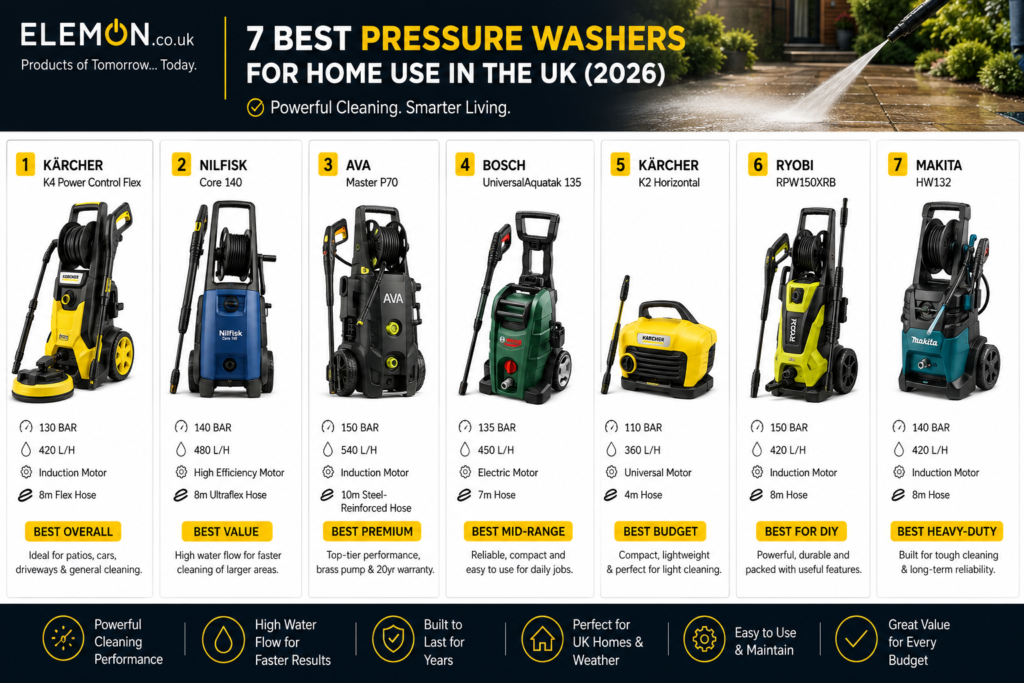
After comparing dozens of popular pressure washers available to UK homeowners, we’ve selected the models that offer the best combination of cleaning performance, reliability, ease of use and long-term value.
Rather than simply choosing the machines with the highest pressure ratings, our recommendations consider:
- Real-world cleaning performance
- Water flow efficiency
- Build quality
- Ease of maintenance
- Accessory compatibility
- Running costs
- Noise levels
- Value for money
- Availability in the UK
1. Kärcher K4 Power Control Flex
⭐ Elemon Rating: 4.9/5
Best Overall Pressure Washer
| Specification | Details |
|---|---|
| Maximum Pressure | 130 BAR |
| Water Flow | 420 L/H |
| Motor | Water-cooled induction |
| Hose Length | 8m Premium Flex Hose |
| Weight | Approx. 12kg |
| Best For | Most UK households |
The Kärcher K4 continues to dominate the UK market for one simple reason—it gets almost everything right.
Instead of chasing extreme pressure figures, Kärcher focuses on delivering balanced performance that suits almost every outdoor cleaning task. Whether you’re washing the family SUV, removing algae from paving slabs or restoring weathered garden furniture, the K4 provides more than enough cleaning power without becoming difficult to control.
The latest Power Control Flex version introduces an improved anti-kink hose, making manoeuvring around vehicles and patios much easier than previous generations.
One feature we particularly like is the integrated pressure indicator on the spray gun. It allows you to adjust the cleaning power instantly without walking back to the machine.
What We Like
✔ Quiet induction motor
✔ Excellent cleaning performance
✔ Fantastic accessory range
✔ Reliable build quality
✔ Very easy to use
✔ Great UK spare parts availability
Could Be Better
✘ Slightly expensive
✘ Plastic body panels scratch easily
Ideal For
- Family homes
- Patios
- Cars
- Decking
- Garden furniture
- General outdoor cleaning
Elemon Verdict
If you only buy one pressure washer this decade, the Kärcher K4 is probably the safest investment.
It delivers professional-looking results while remaining simple enough for complete beginners.

2. Nilfisk Core 140
⭐ Elemon Rating: 4.8/5
Best Value for Money
| Specification | Details |
|---|---|
| Pressure | 140 BAR |
| Water Flow | 480 L/H |
| Motor | High efficiency |
| Hose | UltraFlex |
| Weight | 10kg |
Nilfisk has quietly become one of Europe’s most respected pressure washer manufacturers.
The Danish company focuses less on flashy marketing and more on engineering.
The Core 140 demonstrates this perfectly.
Its impressive 480 litres per hour water flow means it often cleans faster than competitors advertising much higher pressure figures.
For larger patios and driveways this extra water volume makes a noticeable difference.
Another major advantage is stability.
Unlike tall pressure washers that frequently tip over, the Nilfisk’s wider wheelbase keeps it firmly planted while moving around the garden.
Pros
✔ Excellent flow rate
✔ Great value
✔ Strong aluminium pump
✔ Very stable
✔ Easy storage
Cons
✘ Smaller accessory range than Kärcher
✘ Less smartphone integration
Elemon Verdict
For homeowners wanting maximum performance without paying premium-brand prices, this is one of the smartest purchases available.
3. AVA Master P70
⭐ Elemon Rating: 5/5
Best Premium Pressure Washer
| Specification | Details |
|---|---|
| Pressure | 150 BAR |
| Flow Rate | 540 L/H |
| Pump | Brass |
| Motor | Induction |
| Warranty | Up to 20 Years |
AVA might not yet enjoy Kärcher’s household recognition in the UK, but among detailing enthusiasts and professional users, its reputation continues to grow rapidly.
The P70 is built more like commercial equipment than a domestic appliance.
Everything feels over-engineered.
The brass pump, heavy-duty hose, robust chassis and excellent stability make it one of the toughest machines available for homeowners.
Its incredibly high water flow also means large driveways can be cleaned much faster than many competing machines.
Pros
✔ Outstanding build quality
✔ Huge cleaning performance
✔ Very long warranty
✔ Premium hose
✔ Excellent engineering
Cons
✘ Expensive
✘ Heavy
Elemon Verdict
If you maintain a large property or regularly clean vehicles, the AVA P70 is one of the finest long-term investments available.
4. Bosch UniversalAquatak 135
⭐ Elemon Rating: 4.6/5
Best Mid-Range Choice
| Specification | Details |
|---|---|
| Pressure | 135 BAR |
| Flow Rate | 450 L/H |
| Motor | Electric |
| Hose | 7m |
| Weight | 8kg |
Bosch has always been known for reliable DIY equipment, and the UniversalAquatak continues that tradition.
It combines respectable cleaning power with a particularly clever three-in-one nozzle system that eliminates the need to constantly swap attachments.
This makes it especially appealing for homeowners wanting straightforward operation.
Pros
✔ Compact
✔ Good cleaning power
✔ Easy setup
✔ Quality accessories
✔ Excellent value
Cons
✘ Hose slightly stiff
✘ Less powerful than premium models
Elemon Verdict
Perfect for homeowners who want dependable performance without unnecessary complexity.
5. Kärcher K2 Horizontal
⭐ Elemon Rating: 4.4/5
Best Budget Pressure Washer
| Specification | Details |
|---|---|
| Pressure | 110 BAR |
| Flow Rate | 360 L/H |
| Weight | 4kg |
| Motor | Universal |
Small, lightweight and surprisingly capable.
The K2 Horizontal is ideal for occasional cleaning around the home.
Its compact design fits easily into sheds, garages or even utility cupboards.
While it won’t replace larger models for serious patio restoration, it’s excellent for:
- Bikes
- Garden tools
- Cars
- Outdoor furniture
- Balconies
- BBQ cleaning
Pros
✔ Very affordable
✔ Compact
✔ Lightweight
✔ Easy to store
Cons
✘ Limited power
✘ Universal motor
✘ Shorter hose
Elemon Verdict
An excellent entry-level pressure washer for smaller households.
6. Ryobi RPW150XRB
⭐ Elemon Rating: 4.7/5
Best for DIY Enthusiasts
Ryobi continues to impress DIY users with durable equipment designed for regular use.
The RPW150XRB delivers strong cleaning performance while maintaining compatibility with Ryobi’s growing range of outdoor accessories.
It’s particularly effective for:
- Fence restoration
- Deck preparation
- Patio cleaning
- Garage floors
Pros
✔ Excellent pressure
✔ Good accessories
✔ Reliable
✔ Great ergonomics
Cons
✘ Larger footprint
Elemon Verdict
A brilliant choice for homeowners who regularly undertake DIY projects throughout the year.
7. Makita HW132
⭐ Elemon Rating: 4.8/5
Best Heavy-Duty DIY Machine
Makita is best known for professional power tools, and that engineering experience carries into its pressure washer range.
The HW132 offers impressive durability and excellent cleaning consistency, making it well suited for demanding users.
Pros
✔ Powerful
✔ Durable
✔ Professional quality
✔ Excellent reliability
Cons
✘ Premium price
Elemon Verdict
Ideal for users who already own Makita tools and appreciate commercial-grade engineering.
Elemon Comparison Table
| Model | Rating | BAR | Water Flow | Best For |
|---|---|---|---|---|
| Kärcher K4 Power Control Flex | ⭐⭐⭐⭐⭐ | 130 | 420 L/H | Overall Winner |
| Nilfisk Core 140 | ⭐⭐⭐⭐⭐ | 140 | 480 L/H | Best Value |
| AVA Master P70 | ⭐⭐⭐⭐⭐ | 150 | 540 L/H | Premium Choice |
| Bosch UniversalAquatak 135 | ⭐⭐⭐⭐☆ | 135 | 450 L/H | Mid-Range |
| Kärcher K2 Horizontal | ⭐⭐⭐⭐☆ | 110 | 360 L/H | Budget |
| Ryobi RPW150XRB | ⭐⭐⭐⭐☆ | 150 | 420 L/H | DIY Projects |
| Makita HW132 | ⭐⭐⭐⭐⭐ | 140 | 420 L/H | Heavy-Duty DIY |
Which Pressure Washer Should You Buy?
| Your Needs | Recommendation |
|---|---|
| Best Overall | Kärcher K4 Power Control Flex |
| Best Budget | Kärcher K2 Horizontal |
| Best Value | Nilfisk Core 140 |
| Best Premium | AVA Master P70 |
| Best DIY | Ryobi RPW150XRB |
| Best Long-Term Investment | Makita HW132 |
| Best for Large Driveways | AVA Master P70 |
| Best for Cars | Kärcher K4 |
| Best for Patios | Nilfisk Core 140 |
Best Pressure Washer by Cleaning Task
| Cleaning Task | Recommended Pressure | Best Machine |
|---|---|---|
| Washing Cars | 100–130 BAR | Kärcher K4 |
| Cleaning Motorcycles | 100 BAR | Kärcher K2 |
| Patio Slabs | 130–150 BAR | Nilfisk Core 140 |
| Block Paving | 140–150 BAR | AVA Master P70 |
| Timber Decking | Adjustable Pressure | Kärcher K4 |
| Brick Walls | 130–140 BAR | Bosch UniversalAquatak |
| Garden Furniture | 100–110 BAR | Kärcher K2 |
| Fencing | 120–130 BAR | Ryobi RPW150XRB |
| Driveways | 145 BAR+ | AVA Master P70 |
| Outdoor Tools | 100 BAR | Kärcher K2 |
Pressure Washer Maintenance Guide
Buying a quality pressure washer is only the beginning. Like any outdoor power tool, regular maintenance is essential if you want reliable performance year after year.
Fortunately, most maintenance tasks take only a few minutes and can significantly extend the life of your machine.
After Every Use
Developing a simple routine after each cleaning session will help prevent unnecessary wear and expensive repairs.
Recommended Checklist
✅ Disconnect the water supply.
✅ Switch off the machine.
✅ Squeeze the trigger to release remaining pressure.
✅ Drain any water left inside the pump.
✅ Remove dirt from the inlet filter.
✅ Wipe down the machine.
✅ Store the hose without tight bends.
These simple steps help protect seals, hoses and internal pump components.
Monthly Maintenance
If you use your pressure washer regularly, inspect it once a month.
| Maintenance Task | Recommended Frequency |
|---|---|
| Clean water filter | Every month |
| Check hose for damage | Monthly |
| Inspect nozzles | Monthly |
| Lubricate O-rings | Every 2–3 months |
| Clean detergent tank | Every month |
| Inspect electrical cable | Monthly |
Preventative maintenance is always cheaper than replacing damaged parts.
Winter Storage Guide
One of the biggest causes of pressure washer failure in the UK is frost damage.
Water expands when frozen.
Even a small amount trapped inside the pump can crack internal components beyond repair.
Before winter storage:
- Disconnect water supply.
- Run the machine for a few seconds without water to remove remaining moisture.
- Drain the hose completely.
- Remove all accessories.
- Store indoors whenever possible.
Never leave a pressure washer full of water inside an unheated shed during freezing weather.
Running Costs
Pressure washers are surprisingly economical to operate.
Typical electricity consumption:
| Motor Size | Estimated Running Cost per Hour* |
|---|---|
| 1400W | Approximately £0.35–£0.45 |
| 1800W | Approximately £0.45–£0.60 |
| 2100W | Approximately £0.55–£0.70 |
*Estimated using average UK domestic electricity prices. Actual costs will vary depending on your tariff.
Water consumption is also relatively modest compared with using a standard garden hose, as the increased pressure allows you to clean surfaces more quickly and efficiently.
Common Pressure Washing Mistakes
Even experienced DIY enthusiasts occasionally make mistakes that can damage surfaces or reduce cleaning performance.
Avoid these common errors:
Using Too Much Pressure
More pressure isn’t always better.
High pressure can damage:
- Timber decking
- Painted fences
- Vehicle paintwork
- Garden furniture
- Brick pointing
Always start with the lowest effective pressure.
Holding the Nozzle Too Close
Keeping the spray tip only a few centimetres away concentrates enormous force onto a tiny area.
Instead:
- Start approximately 30–50 cm away.
- Move closer gradually if required.
Ignoring Water Filters
Blocked filters reduce water flow, making the pump work harder and increasing wear.
Cleaning the inlet filter takes less than a minute.
Using Hot Water
Unless your pressure washer is specifically designed for hot water, always use cold mains water.
Hot water can damage seals and shorten pump life.
Leaving Chemicals Inside
Detergents should always be flushed through with clean water after use.
This helps prevent blockages and corrosion.
Pressure Washing Different Surfaces
Every surface requires a slightly different approach.
| Surface | Recommended Pressure | Notes |
|---|---|---|
| Cars | Low | Use foam lance where possible |
| Motorcycles | Low | Avoid wheel bearings |
| Decking | Medium | Spray with wood grain |
| Brick Walls | Medium | Avoid loose mortar |
| Concrete | High | Use rotary nozzle if needed |
| Garden Furniture | Low | Keep moving continuously |
| Fencing | Medium | Test on hidden section first |
| Natural Stone | Medium | Avoid prolonged close spraying |
| Roof Tiles | Low | Only if manufacturer recommends |
Pressure Washer Accessories Worth Considering
Many accessories can dramatically improve cleaning results.
Surface Cleaner
Ideal for:
- Patios
- Block paving
- Driveways
Benefits:
- Faster cleaning
- Less overspray
- More even finish
Foam Cannon
Perfect for:
- Cars
- Vans
- Motorhomes
- Motorcycles
Produces thick snow foam that loosens dirt before rinsing.
Rotary Nozzle
Excellent for:
- Moss
- Algae
- Concrete
- Stone
Not recommended for painted surfaces.
Gutter Cleaning Kit
Allows safe cleaning from ground level without climbing ladders.
Extension Lance
Useful for:
- Conservatories
- High walls
- Caravans
- Roof edges
Choosing the Right Pressure Washer for Your Home
Small Flats or Terraces
Recommended:
- Kärcher K2
Suitable for:
- Cars
- Bikes
- Balconies
- Small patios
Average Family Homes
Recommended:
- Kärcher K4
- Bosch UniversalAquatak
Suitable for:
- Cars
- Decking
- Patios
- Garden furniture
Large Properties
Recommended:
- Nilfisk Core 140
- AVA Master P70
Suitable for:
- Large driveways
- Stone patios
- Multiple vehicles
- Heavy-duty cleaning
Frequently Asked Questions
Can a pressure washer damage concrete?
Yes.
Holding a powerful rotary nozzle too close can erode the surface over time.
Is it safe to wash a car?
Absolutely.
Use:
- Lower pressure
- Wide fan nozzle
- Foam lance
Avoid spraying directly into wheel bearings, electrical connectors or damaged paintwork.
How often should I pressure wash my patio?
Most UK patios benefit from a thorough clean once or twice each year.
Shaded gardens with significant moss growth may require more frequent maintenance.
Do pressure washers use lots of water?
Surprisingly, no.
Because they clean more efficiently than a standard hose, overall water usage is often lower for the same task.
Are expensive pressure washers worth it?
If you only clean a bicycle twice a year, probably not.
However, homeowners who regularly maintain patios, driveways, decking and vehicles will usually benefit from the improved durability, quieter operation and superior cleaning performance offered by premium models.
Key Takeaways
- Choose water flow as carefully as pressure.
- Induction motors offer better longevity and quieter operation.
- Aluminium and brass pumps generally last much longer than plastic alternatives.
- Anti-kink hoses significantly improve ease of use.
- Always match the pressure to the surface being cleaned.
- Regular maintenance helps maximise lifespan.
- Store your pressure washer indoors during freezing weather.
- Buying quality usually saves money over the long term.
Related Articles on Elemon.co.uk
If you enjoyed this guide, you may also like:
- Best Cordless Drills in the UK (2026 Review)
- Best DIY Tool Kits for Beginners
- Smart Garden Gadgets for Summer 2026
- Best Smart Plugs and How to Use Them
- Best Robot Vacuums for Busy Families
- The Smart Shopper’s Guide: Where to Buy Tech and Smart Home Gear in the UK
- Best Smart Doorbells for UK Homes
- Modern DIY Meets Smart Living: Essential Home Upgrade Ideas
UK Regulations & Safety Information
Pressure washers are powerful machines and should always be operated responsibly.
Before using your pressure washer:
- Read the manufacturer’s instruction manual thoroughly.
- Wear appropriate eye protection, gloves and non-slip footwear.
- Keep children and pets away from the working area.
- Never direct the spray at people, animals or electrical equipment.
- Use an outdoor-rated extension lead if one is required.
- Follow all applicable UK electrical safety guidance when using outdoor power equipment.
- Dispose of detergents and cleaning chemicals responsibly in accordance with local environmental regulations.
Always inspect the machine, hose and electrical cable before each use. If any damage is found, discontinue use until the equipment has been repaired or replaced.
Disclaimer
This article is intended for general informational and educational purposes only. Product specifications, features, pricing and availability may change over time. Always verify the latest information with the manufacturer or retailer before making a purchase. The recommendations in this guide reflect independent editorial opinions based on research, specifications and intended use cases.
Affiliate Disclaimer
As an Amazon Associate, Elemon.co.uk may earn a small commission from qualifying purchases made through affiliate links. This comes at no additional cost to you and helps support the creation of independent reviews, buying guides and DIY content. Our recommendations are based on product quality, value and suitability—we do not recommend products solely because they offer affiliate commissions.
Image Notice: All images used within this article are for illustrative and reference purposes only. Actual product appearance, accessories and specifications may vary depending on the manufacturer, production updates or regional availability.