
🏠 My Recommended Smart Home Starter Kit UK
My Experience
Over the last few years, I’ve been slowly building and testing different smart home setups in real UK homes — not lab environments or sponsored demo setups, but everyday living spaces like flats, terraced houses, and modern apartments.
What I’ve learned is simple: most people overcomplicate smart homes.
They either:
- Buy too many devices at once
- Mix incompatible ecosystems
- Or spend far more than they need to
The truth is, a smart home that actually improves your life can start with just three types of devices: a smart speaker, smart plugs, and smart lighting.
Once you understand how these three work together, everything else becomes an optional upgrade rather than a confusing starting point.
In this guide, I’ll walk through the exact starter setups I’d personally recommend in 2026 for UK homes, based on ease of use, reliability, and real-world value.
Why Smart Homes Feel Complicated (And How to Fix That)
Most beginners get overwhelmed because they focus on products instead of systems.
A smart home is not about buying gadgets — it’s about building an ecosystem where everything communicates properly.
The main issue I see is fragmentation:
- One brand for lights
- Another for plugs
- Another app for cameras
- And none of them working together properly
This is exactly why choosing an ecosystem first is so important.
Today, the main three ecosystems are:
- Amazon Alexa
- Google Home
- Apple Home
Each one works well, but the key is consistency.
Thanks to Matter (the universal smart home standard), things are improving significantly in 2026. Devices from different brands can now communicate more easily than ever before — but you still get the best experience when you stick to one main platform.
The Best Smart Home Starter Kit UK (My Recommended Setup)
If I had to rebuild a smart home from scratch in a UK property today, I would keep things very simple.
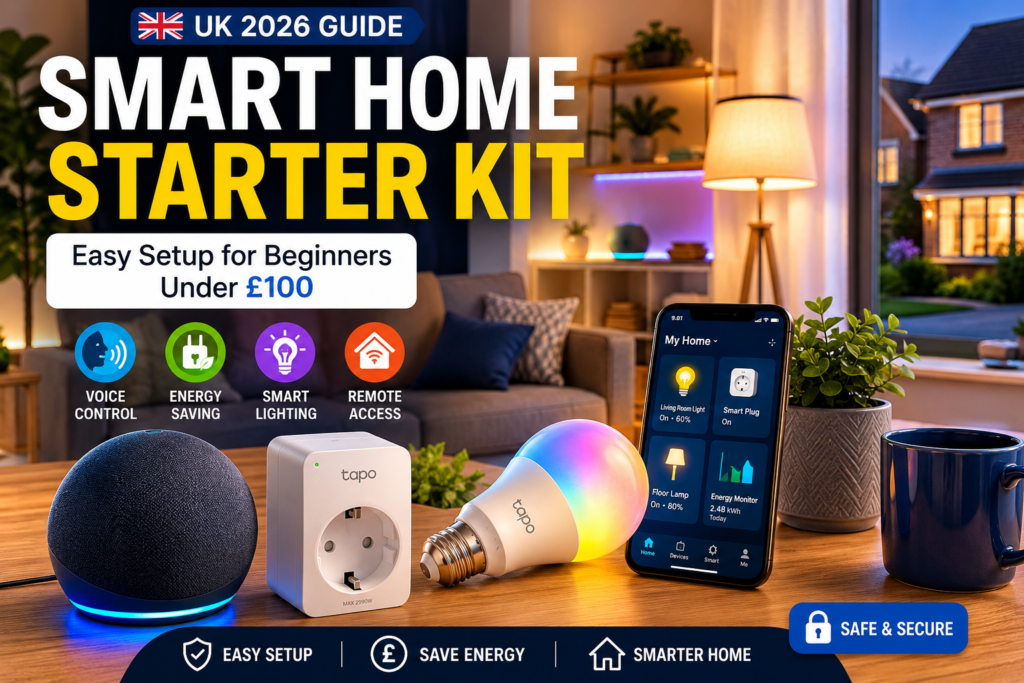
My core starter kit would be:
- Amazon Echo Dot (5th Gen)
- TP-Link Tapo P110M Smart Plugs
- TP-Link Tapo Smart Bulbs (B22 or E27 depending on home)
This setup works because it solves real daily problems without overengineering anything.
Why this combination works so well
The Echo Dot becomes your “brain”. It handles:
- Voice control
- Routines
- Device grouping
- Automation commands
The Tapo devices handle:
- Lighting control
- Appliance switching
- Energy monitoring
And the best part — no hub is required.
Everything connects over Wi-Fi, making setup extremely beginner-friendly.
Smart Plugs: The Most Underrated Smart Home Device
If I had to pick just one device that gives the most immediate value, it would be smart plugs.
Most people underestimate them until they use them for a week.
In real UK homes, I’ve found them especially useful for:
- Electric heaters
- Floor lamps
- Kitchen appliances
- Phone chargers
- TV entertainment setups
The TP-Link Tapo P110M is particularly useful because it includes energy monitoring.
Why energy monitoring matters in the UK
Electricity pricing in the UK means standby power actually adds up.
You’ll often discover:
- TVs using power even when “off”
- Game consoles constantly drawing electricity
- Chargers left plugged in consuming energy
With smart plugs, you can track everything and shut it down automatically.
This alone can reduce wasted energy without changing your habits.
Smart Lighting: The Upgrade You Feel Immediately
Smart lighting is usually the first upgrade people actually notice.
Unlike other smart devices, lighting changes the atmosphere of your home instantly.
With smart bulbs, you can:
- Dim lights automatically in the evening
- Match lighting to time of day
- Set “movie mode” or “relax mode”
- Control everything by voice
Even small changes like warm lighting at sunset make a noticeable difference in comfort.
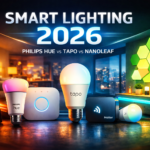
Philips Hue (Premium Option)
If you want reliability and quality, Philips Hue is still the benchmark.
It uses Zigbee instead of Wi-Fi overload, which means:
- Faster response
- Better stability
- Fewer dropouts
- Easier scaling across multiple rooms
Yes, it costs more — but it performs like a mature system, not a budget gadget setup.
Building a Smart Home on a Budget (Under £100 Reality Check)
One of the biggest misconceptions is that smart homes are expensive.
In reality, a very functional setup can be built for under £100 in the UK.
Example starter setup:
- Amazon Echo Dot → ~£45
- Tapo Smart Plug 2-pack → ~£20
- Tapo Smart Bulb 2-pack → ~£18
Total: ~£83
This already allows you to:
- Control appliances by voice
- Automate lighting schedules
- Turn devices on/off remotely
- Monitor energy usage
- Create basic routines
This is not a “toy setup” — it’s a genuinely useful system for everyday life.
Real-World Automations That Actually Matter
A smart home only becomes valuable when it saves time or effort.
Here are automations I personally recommend starting with:
1. “Goodnight Routine”
One command:
- Turns off all lights
- Switches off plugs
- Lowers brightness
- Sets night mode
2. “Leaving Home Mode”
- Turns off appliances
- Switches off unnecessary devices
- Reduces energy usage
- Prepares security devices
3. “Evening Lighting Mode”
- Lights turn on automatically at sunset
- Warm tone activated
- Brightness reduced for comfort
These are simple, but they make daily life noticeably easier.
Smart Home Platform Comparison (UK Perspective)
Choosing the right ecosystem is more important than choosing devices.
| Platform | Best For | Strength |
|---|---|---|
| Amazon Alexa | Beginners | Huge compatibility |
| Google Home | Smart routines | Best AI voice control |
| Apple Home | Privacy-focused users | Strong security + iPhone integration |
If you’re unsure, Alexa is still the easiest entry point in the UK due to device availability and pricing.
Future Expansion Ideas (Once You’re Ready)
Once your starter kit feels natural, you can expand into:
- Smart thermostats
- Security cameras
- Video doorbells
- Motion sensors
- Smart locks
- Leak detectors
- Smart blinds
The key is not to rush.
A smart home becomes more powerful when it grows gradually, not all at once.
✓ My Experience
From everything I’ve tested, the biggest real-world impact comes from simple automation — not complex systems.
Smart plugs consistently deliver the highest practical value because they remove the “did I leave that on?” problem.
Smart lighting comes next because it improves comfort instantly without requiring behavioural change.
The biggest mistake I’ve made (and seen others make) is buying too much too early.
A small, stable system always performs better than a large, messy one.
✓ Key Takeaways
- Start with one ecosystem (Alexa, Google, or Apple)
- Smart plugs provide the fastest value
- Smart lighting improves daily comfort instantly
- Matter is improving compatibility across brands
- A full starter setup can cost under £100 in the UK
- Expand slowly rather than buying everything at once
- Simplicity beats complexity in smart homes
✓ Related Articles
- Best Smart Lighting Systems UK 2026
- How to Reduce Electricity Bills with Smart Plugs
- Smart Home Automation Ideas for Beginners
- Ultimate Guide to Home Energy Saving Devices UK
- Philips Hue vs Budget Smart Bulbs Comparison
✓ Disclaimer
This article is based on personal experience, product testing insights, and general research. Prices, features, and compatibility may change over time. Always verify specifications before purchasing or installing smart home equipment.
As an Amazon Associate, Elemon.co.uk earns from qualifying purchases at no extra cost to you.
✓ UK Regulations & Safety Information
When installing smart home devices in the UK:
- Only use UKCA or CE certified products
- Do not overload smart plugs or extension sockets
- Avoid high-power appliances unless explicitly supported
- Use qualified electricians for wired installations
- Follow UK Building Regulations where applicable
- Keep electrical devices away from moisture and heat sources
- Always follow manufacturer instructions
✓ All Images Are for Reference Purposes
All images associated with this article are for illustration purposes only. Actual product design, features, and packaging may vary depending on manufacturer updates and UK retail versions.