
Best Tools Under £100 in the UK (2026): Build a Better Workshop Without Breaking Your Budget
Welcome to Elemon.co.uk—where we bring you the Products of Tomorrow… Today.
A great workshop isn’t built overnight, and it certainly doesn’t require thousands of pounds worth of professional equipment. Whether you’re a homeowner tackling weekend DIY projects, a first-time buyer furnishing your home, or someone upgrading from worn-out budget tools, the £100 price point offers some of the best value available in today’s UK market. Years ago, buying affordable tools often meant accepting poor quality. Cheap motors overheated, batteries lasted only a few minutes, and screwdriver bits rounded off after a handful of screws. Spending less usually meant buying twice. Fortunately, that landscape has changed dramatically.
Modern manufacturing techniques, improved lithium-ion battery technology, brushless motors, and increased competition between leading brands have created an exciting opportunity for UK DIY enthusiasts. Today, many professional-grade tools are available for less than £100, especially if you’re happy to purchase “body-only” versions compatible with an existing battery platform.
At Elemon.co.uk, we believe smart buying is about more than simply choosing the cheapest product. It’s about investing in tools that deliver excellent performance, reliability, safety, and long-term value.
In this comprehensive guide, we’ll explore some of the very best tools available under £100 in the UK, explain what separates genuine bargains from false economy, and help you choose equipment that will serve you for years rather than months.
Affiliate Disclaimer: As an Amazon Associate, Elemon.co.uk may earn a commission from qualifying purchases at no extra cost to you.
Why £100 Is the Sweet Spot for DIY Tools
Many people automatically assume that higher prices always mean better performance. While that can sometimes be true, the sub-£100 market has become incredibly competitive.
Manufacturers know this is where most homeowners shop, meaning they often introduce their best-value products at this price point.
Benefits include:
- Professional quality without premium prices
- Better warranties
- Stronger motors
- Improved battery technology
- Safer operation
- Better ergonomics
- Higher-quality materials
- Excellent spare parts availability
Rather than paying for features you’ll rarely use, many sub-£100 tools focus on delivering outstanding everyday performance.
For most homeowners, that’s exactly what’s needed.
What Makes a Tool Worth Buying?
Before looking at individual products, it’s worth understanding what actually determines quality.
Price alone tells very little.
Instead, consider the following.
Build Quality
A quality tool should feel solid without being unnecessarily heavy.
Look for:
- Metal gearboxes
- Reinforced housings
- Rubber over-mould grips
- Quality switches
- Well-balanced weight distribution
These characteristics usually indicate better internal engineering.
Motor Technology
Power tools now generally fall into two categories.
| Brushed Motor | Brushless Motor |
|---|---|
| Lower purchase cost | Higher efficiency |
| More maintenance | Longer lifespan |
| Slightly noisier | Cooler operation |
| Less battery efficient | Longer runtime |
| Ideal for occasional users | Ideal for frequent DIY |
If you can purchase a brushless version within your £100 budget, it’s often worth spending the extra money.

Battery Ecosystem
One of the biggest mistakes new DIY enthusiasts make is buying different brands every time they purchase a tool.
Instead, choose one ecosystem.
Popular UK battery platforms include:
| Brand | Battery Platform |
|---|---|
| Bosch | Power For All 18V |
| Ryobi | ONE+ |
| Makita | LXT |
| DeWalt | XR |
| Stanley | FatMax V20 |
| Einhell | Power X-Change |
Once you own batteries and chargers, future purchases become significantly cheaper because many tools are available as body-only units.
Warranty
Never ignore warranty registration.
Many premium manufacturers extend standard warranties free of charge after online registration.
This can increase protection from one year to three years or more.
Always check registration requirements shortly after purchase.
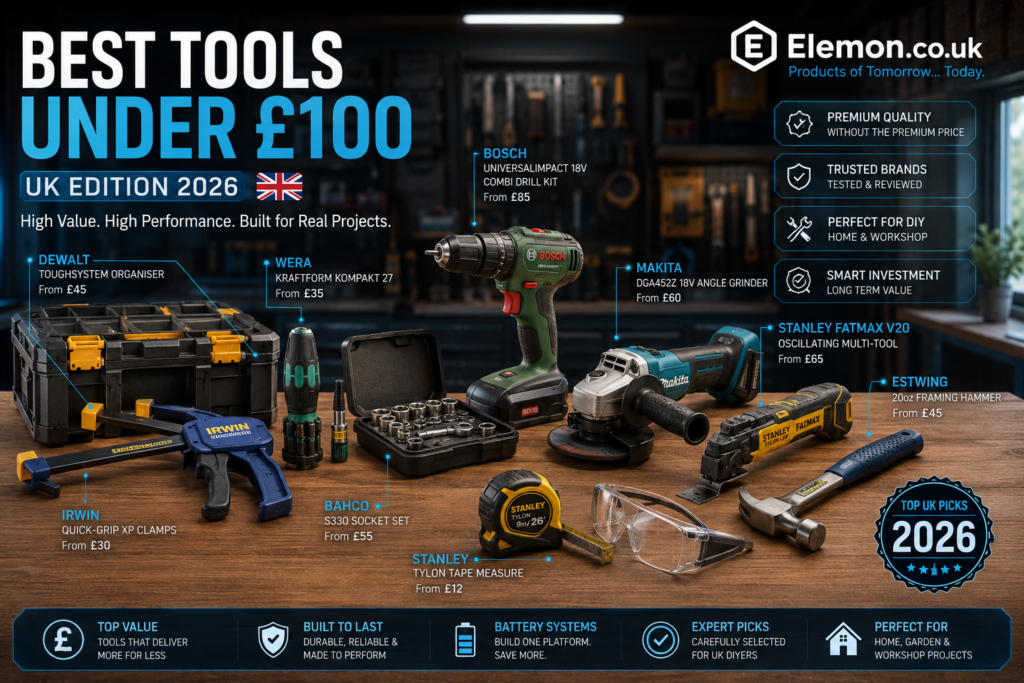
Best Tools Under £100 (UK Edition)
Below are our favourite high-value tools available for UK buyers in 2026.
Each product has been selected based on value, reliability, performance, and overall usefulness.
1. Bosch UniversalImpact 18V Cordless Combi Drill
| Specification | Details |
|---|---|
| Category | Cordless Combi Drill |
| Average UK Price | £85–£99 |
| Best For | General Home DIY |
| Rating | ⭐⭐⭐⭐⭐ |
A cordless combi drill remains one of the first purchases every homeowner should make.
Whether assembling furniture, hanging shelves, fitting curtain rails, drilling into brickwork or completing outdoor projects, few tools are used more frequently.
The Bosch UniversalImpact 18V offers an excellent balance between affordability and performance.
Its two-speed gearbox provides enough versatility for delicate screwdriving while still producing sufficient torque for heavier drilling applications.
The integrated hammer mode makes short work of most domestic brick walls, making it ideal for UK homes constructed from masonry.
Unlike many cheaper alternatives, Bosch’s Electronic Cell Protection helps prolong battery life by preventing overheating and over-discharge.
Pros
✔ Excellent starter kit
✔ Comfortable grip
✔ Reliable Bosch quality
✔ Good battery compatibility
✔ Ideal for beginners
Cons
✘ Not designed for heavy commercial work
✘ 10mm chuck limits very large drill bits
Why Elemon Recommends It
This is one of the easiest recommendations for anyone starting their DIY journey. It provides dependable performance, excellent reliability and access to Bosch’s extensive Power For All ecosystem.
2. Wera Kraftform Kompakt 27 Screwdriver Set
| Specification | Details |
|---|---|
| Category | Ratcheting Screwdriver |
| Average Price | £35–£45 |
| Rating | ⭐⭐⭐⭐⭐ |
Every workshop deserves at least one premium manual screwdriver.
The Wera Kraftform Kompakt 27 isn’t simply another screwdriver—it replaces an entire drawer full of low-quality alternatives.
Its ergonomic handle has been carefully designed to reduce fatigue while increasing torque transfer.
Inside the handle, six premium-quality bits are stored neatly and securely, making it an incredibly practical everyday companion.
The fine-tooth ratchet mechanism also allows work in confined spaces where a conventional screwdriver would require constant repositioning.
Key Features
- Fine-tooth ratchet
- Quick-release bit holder
- Premium hardened bits
- Excellent grip
- Compact storage
Pros
✔ German engineering
✔ Outstanding durability
✔ Comfortable during extended use
✔ Compact
✔ Extremely precise
Cons
✘ Higher initial cost than budget sets
Why Elemon Recommends It
This is one of those rare tools that you’ll likely still own twenty years from now.
3. Bahco S330 Socket Set
| Specification | Details |
|---|---|
| Category | Socket Set |
| Average Price | £55–£65 |
| Rating | ⭐⭐⭐⭐⭐ |
Every homeowner eventually encounters jobs involving stubborn nuts and bolts.
From bicycles and lawnmowers to furniture, plumbing and automotive repairs, a quality socket set quickly becomes indispensable.
Bahco has built a reputation over decades for manufacturing exceptional hand tools, and the S330 continues that tradition.
Manufactured using high-quality Chrome Vanadium steel, the sockets resist rounding while providing excellent durability under heavy loads.
The slim-profile ratchets also make accessing confined areas considerably easier.
Unlike many inexpensive competitors, the storage case feels robust and securely holds each component in place during transport.
What’s Included
- 34 precision sockets
- Extension bars
- Quick-release ratchets
- Universal joints
- Durable storage case
Pros
✔ Professional quality
✔ Excellent chrome finish
✔ Long-lasting
✔ Smooth ratchet action
✔ Reliable locking case
Cons
✘ Smaller selection than larger professional kits
Why Elemon Recommends It
This set represents outstanding value and offers quality that far exceeds its price tag.
Quick Comparison Table
| Tool | Best For | Approx Price | Elemon Rating |
|---|---|---|---|
| Bosch UniversalImpact 18V | Everyday DIY | £89 | ⭐⭐⭐⭐⭐ |
| Wera Kraftform Kompakt 27 | Household Repairs | £39 | ⭐⭐⭐⭐⭐ |
| Bahco S330 Socket Set | Mechanical Work | £60 | ⭐⭐⭐⭐⭐ |

How We Selected These Tools
Unlike simple online product round-ups, our recommendations are based on factors that genuinely matter to UK homeowners.
We considered:
- Build quality
- Long-term reliability
- Brand reputation
- Availability of spare parts
- UK customer feedback
- Warranty support
- Ease of use
- Value for money
- Battery ecosystem compatibility
- Safety features
Rather than chasing the lowest price, we’ve focused on products that continue delivering reliable performance year after year.
In our experience, spending a little more on a trusted brand often saves money in the long run by avoiding premature replacements and frustrating failures.
4. Makita DGA452Z 18V Cordless Angle Grinder (Body Only)
| Specification | Details |
|---|---|
| Category | Angle Grinder |
| Average UK Price | £60–£75 |
| Best For | Metal Cutting & Masonry |
| Rating | ⭐⭐⭐⭐⭐ |
If you’re planning to renovate a property, install a metal fence, restore rusty gates, cut paving slabs, or remove old bolts, an angle grinder quickly becomes one of the most useful tools in your workshop.
The Makita DGA452Z has remained popular for years because it delivers professional performance without unnecessary extras that increase the price.
Powered by Makita’s trusted 18V LXT battery platform, this grinder reaches approximately 11,000 RPM, making light work of steel, stone, ceramic tiles, and masonry when paired with the correct cutting disc.
One of its standout features is the electronic current limiter, which protects the motor during demanding cuts. This not only improves reliability but also helps prevent overheating during extended use.
Ideal Projects
- Removing rust
- Cutting steel
- Trimming paving slabs
- Garden renovations
- Fence repairs
- Removing seized bolts
Pros
✔ Excellent build quality
✔ Powerful motor
✔ Comfortable grip
✔ Reliable safety features
✔ Huge Makita battery ecosystem
Cons
✘ Battery and charger sold separately
✘ Discs purchased separately
Why Elemon Recommends It
If you’re already invested in Makita’s battery platform, few angle grinders offer this level of quality for under £100.

5. Stanley FatMax V20 Oscillating Multi-Tool
| Specification | Details |
|---|---|
| Category | Multi-Tool |
| Average UK Price | £65–£80 |
| Rating | ⭐⭐⭐⭐☆ |
Many DIY enthusiasts don’t realise how useful an oscillating multi-tool is until they own one.
Instead of spinning like a drill or moving like a jigsaw, the blade oscillates rapidly through a very small angle. This produces incredibly accurate cuts with minimal damage to surrounding materials.
The Stanley FatMax V20 is especially useful for:
- Cutting skirting boards
- Door frame adjustments
- Grout removal
- Sanding corners
- Plunge cuts
- Floor repairs
Its tool-free blade change system is one of its biggest advantages.
Changing accessories takes only seconds without searching for Allen keys or spanners.
Pros
✔ Extremely versatile
✔ Comfortable vibration control
✔ Excellent blade change system
✔ Integrated LED light
Cons
✘ Batteries sold separately
Why Elemon Recommends It
Rather than replacing several specialist tools, this single machine can perform dozens of different jobs around the home.
6. DeWalt ToughSystem Organiser
| Specification | Details |
|---|---|
| Category | Storage |
| Average Price | £45–£70 |
| Rating | ⭐⭐⭐⭐⭐ |
The best tools quickly become frustrating if they’re scattered around the garage.
A quality organiser protects your investment and saves valuable time.
The DeWalt ToughSystem organiser features removable bins, heavy-duty clips and a weather-resistant construction suitable for garages, vans and workshops.
It also integrates with the wider ToughSystem range, allowing your storage to grow alongside your collection.
Best For
- Screws
- Rawl plugs
- Drill bits
- Electrical connectors
- Plumbing fittings
- Small hand tools
7. Irwin Quick-Grip XP Clamps
| Specification | Details |
|---|---|
| Category | Clamps |
| Average Price | £30–£50 |
| Rating | ⭐⭐⭐⭐⭐ |
Many beginners underestimate the importance of clamps.
Professionals often say:
“You can never own too many clamps.”
Whether you’re gluing timber, assembling furniture or holding materials during cutting, quality clamps make every project easier and safer.
Irwin’s Quick-Grip XP range offers impressive clamping force while remaining easy to operate with one hand.
8. Estwing 20oz Framing Hammer
| Specification | Details |
|---|---|
| Category | Hand Tool |
| Average Price | £45–£60 |
| Rating | ⭐⭐⭐⭐⭐ |
Made from a single piece of forged American steel, the Estwing framing hammer has earned an almost legendary reputation among builders.
Unlike cheaper wooden-handled alternatives, it won’t loosen over time.
The genuine leather grip provides excellent comfort while reducing vibration.
This is the sort of hammer many professionals keep for decades.
Comparison Table
| Product | Category | Typical Price | Best For | Rating |
|---|---|---|---|---|
| Makita DGA452Z | Angle Grinder | £70 | Renovation | ⭐⭐⭐⭐⭐ |
| Stanley FatMax V20 | Multi-Tool | £72 | Versatility | ⭐⭐⭐⭐☆ |
| DeWalt ToughSystem | Storage | £60 | Organisation | ⭐⭐⭐⭐⭐ |
| Irwin Quick-Grip XP | Clamps | £40 | Woodworking | ⭐⭐⭐⭐⭐ |
| Estwing Framing Hammer | Hand Tool | £55 | Construction | ⭐⭐⭐⭐⭐ |
Brushless vs Brushed Motors
One of the biggest decisions when purchasing power tools is choosing between brushed and brushless technology.
Brushed Motors
Advantages
- Lower purchase price
- Proven technology
- Easier repairs
Disadvantages
- Brushes eventually wear out
- More heat generated
- Lower efficiency
- Reduced battery runtime
Brushless Motors
Advantages
- Longer lifespan
- Higher efficiency
- More power
- Longer battery life
- Less maintenance
- Cooler operation
Disadvantages
- Higher purchase price
Which Should You Buy?
If you only use power tools a few weekends each year, brushed motors still represent excellent value.
However, if you regularly tackle DIY projects or intend to expand your workshop, investing in brushless tools can save money over time through improved durability and battery efficiency.
Corded vs Cordless
Another common question is whether corded tools still make sense.
The answer depends on how you work.
| Corded | Cordless |
|---|---|
| Unlimited runtime | Excellent portability |
| Usually more powerful | Ideal outdoors |
| Lower purchase cost | No extension leads |
| Better for workshops | Faster setup |
For garages and home workshops with easy access to mains electricity, corded tools often provide exceptional value.
For ladders, gardens and remote locations, cordless tools are usually the better choice.
How to Build a Workshop for Under £500
You don’t need thousands of pounds to create a capable DIY workspace.
Here’s one example of a balanced starter setup.
| Tool | Approx Price |
|---|---|
| Bosch Combi Drill | £90 |
| Wera Screwdriver | £40 |
| Bahco Socket Set | £60 |
| Stanley Multi-Tool | £70 |
| Irwin Clamps | £40 |
| Estwing Hammer | £55 |
| Spirit Level | £25 |
| Tape Measure | £15 |
| Safety Glasses & Gloves | £25 |
| Tool Storage | £70 |
Estimated Total: Approximately £490
This collection will comfortably handle hundreds of common DIY tasks, from assembling furniture and fitting shelves to building decking, repairing fences, installing lighting, and carrying out routine home maintenance.
My Experience
Over the years, I’ve learned that buying the cheapest available tool is rarely the most economical decision. Early in my DIY journey, I picked up several low-cost kits that looked impressive because they contained dozens of pieces. Unfortunately, many of those tools wore out quickly, and some became unreliable after only a handful of projects. Switching to trusted brands made a noticeable difference. Better ergonomics reduced fatigue during longer jobs, motors ran cooler under load, and hand tools provided a more secure grip with less risk of damaging fixings. While the initial cost was slightly higher, the improvement in performance and durability meant I spent less replacing worn-out equipment. For most homeowners, building a workshop gradually is often the smartest approach. Start with a dependable drill, quality screwdrivers, a socket set, and essential measuring tools. As your projects become more ambitious, expand into specialist equipment such as angle grinders, oscillating multi-tools, or circular saws. This approach spreads the cost while ensuring every purchase adds genuine value to your toolkit.
Smart Buying Tips
Before purchasing your next tool, keep these practical tips in mind:
- Choose a battery platform: Sticking with one cordless system reduces long-term costs.
- Read beyond the headline price: Check whether batteries, chargers, or accessories are included.
- Consider future projects: Buying a slightly more capable tool today may save you upgrading later.
- Invest in safety gear: Safety glasses, hearing protection, gloves, and dust masks are essential companions to any power tool.
- Register your warranty: Many manufacturers offer extended warranty periods when products are registered soon after purchase.
Tool Maintenance Tips: Make Your Investment Last
Even the highest-quality tools need proper care. A few simple habits can significantly extend their lifespan, improve performance, and reduce the risk of breakdowns.
Clean After Every Project
Dust, sawdust, concrete residue, and metal filings can build up inside moving parts and ventilation ports.
After each use:
- Wipe down the exterior with a dry cloth.
- Use compressed air to clear cooling vents.
- Remove debris from chucks, blades, and moving components.
- Store tools only after they are completely dry.
Look After Your Batteries
Lithium-ion batteries perform best when treated correctly.
To maximise battery life:
- Avoid storing batteries fully discharged.
- Recharge before they reach 0%.
- Keep batteries away from excessive heat or freezing temperatures.
- Remove batteries from tools during long-term storage.
- Use the original charger whenever possible.
Inspect Before Use
Before starting any project, take a minute to check:
- Loose screws
- Cracked housings
- Frayed power cables
- Damaged battery contacts
- Worn cutting discs
- Dull blades
- Missing safety guards
Replacing inexpensive accessories early can prevent expensive repairs later.
Keep Cutting Accessories Sharp
Blunt blades force motors to work harder, increasing heat and reducing battery life.
Replace or sharpen:
- Drill bits
- Circular saw blades
- Oscillating blades
- Jigsaw blades
- Router bits
- Hole saws
Sharp accessories also produce cleaner, safer cuts.
Essential Workshop Safety Equipment
No workshop is complete without proper personal protective equipment (PPE).
We recommend keeping the following items readily available:
| Safety Equipment | Why It Matters |
|---|---|
| Safety glasses | Protect eyes from flying debris |
| Ear defenders | Reduce exposure to loud power tools |
| Dust mask or respirator | Minimise inhalation of wood, plaster, or masonry dust |
| Cut-resistant gloves | Improve grip and protect hands during handling |
| Steel-toe footwear | Reduce injury risk from dropped tools or materials |
| High-visibility clothing (where appropriate) | Improves visibility on larger projects |
Safety equipment is often one of the best-value investments you can make.
Common Mistakes to Avoid
Many beginners make avoidable purchasing decisions. Here are some of the most common:
Buying Based on Piece Count
A 250-piece tool kit isn’t automatically better than a 50-piece premium set. Quality almost always outweighs quantity.
Mixing Battery Platforms
Owning multiple chargers and incompatible batteries quickly becomes expensive and inconvenient.
Ignoring Ergonomics
A tool that feels uncomfortable after ten minutes may become frustrating during longer projects. Whenever possible, handle a tool before buying.
Forgetting Replacement Costs
Consider the price and availability of replacement blades, discs, batteries, and accessories before committing to a tool platform.
Choosing Price Over Reliability
The cheapest option can become the most expensive if it needs replacing after only a few uses.
Frequently Asked Questions
Are tools under £100 suitable for serious DIY?
Yes. Many reputable brands now offer excellent tools below £100 that comfortably handle the majority of home improvement projects. Choosing well-built models from trusted manufacturers is more important than simply spending more.
Should I buy cordless or corded tools?
Cordless tools offer excellent convenience and portability, making them ideal for gardens, lofts, and outdoor work. Corded tools often provide continuous power and can be a better choice for longer or heavier tasks where access to mains electricity isn’t an issue.
Is a brushless motor worth the extra cost?
If you use your tools regularly, brushless motors generally provide better efficiency, longer runtime, reduced maintenance, and improved durability. Occasional DIY users may still find brushed tools offer excellent value.
Which battery platform is best?
There isn’t a single “best” platform—it depends on your needs. Bosch, Makita, DeWalt, Ryobi, Stanley FatMax, and Einhell all offer strong ecosystems. The key is to choose one platform and build around it to save money on future purchases.
Can beginners buy professional tools?
Absolutely. Many professional-grade tools are designed to be user-friendly. Investing in quality equipment from the start can improve safety, performance, and long-term value.
Key Takeaways
- A budget of under £100 can buy high-quality, reliable tools suitable for most home DIY tasks.
- Focus on build quality, ergonomics, and long-term value rather than simply choosing the lowest price.
- Selecting a single battery ecosystem helps reduce costs as your workshop grows.
- Brushless motors are worth considering if you regularly tackle DIY projects.
- Proper maintenance and safe working practices will extend the life of your tools and improve overall performance.
Related Articles on Elemon.co.uk
Continue building your workshop with these guides:
- Best Cordless Drills in the UK (2026 Review)
- Best DIY Tool Kits for Beginners
- Best Angle Grinders for Home Projects
- Best Laser Levels for Accurate DIY Builds
- Best Pressure Washers for Home Use
- Smart Home Starter Kit Guide
- Essential DIY Tools Every New Homeowner Needs
- Corded vs Cordless Power Tools Explained
UK Regulations & Safety Information
When using power tools in the UK:
- Always follow the manufacturer’s operating instructions.
- Wear suitable PPE, including eye and hearing protection where appropriate.
- Ensure electrical equipment complies with UK safety standards and is suitable for use with UK mains power.
- Inspect cables, plugs, and extension leads before each use.
- Use RCD (Residual Current Device) protection when operating mains-powered tools outdoors.
- Dispose of damaged batteries responsibly through authorised recycling facilities rather than household waste.
- Keep power tools out of the reach of children and store them securely when not in use.
Safe working practices help reduce the risk of injury and protect your equipment.
Disclaimer: The information provided in this article is intended for general guidance and educational purposes only. While every effort has been made to ensure accuracy at the time of publication, product specifications, prices, availability, and manufacturer information may change over time. Always verify the latest details with the retailer or manufacturer before making a purchase.
Affiliate Disclaimer: As an Amazon Associate, Elemon.co.uk may earn from qualifying purchases. This comes at no additional cost to you and helps support our independent reviews, buying guides, and DIY content.
Image Disclaimer: All images used in this article are for illustrative and reference purposes only. Product appearance, accessories, colours, and specifications may vary depending on manufacturer updates and regional availability.